
Decanter Centrifuges
Decanter centrifuges are used in the separation of solid-liquid or solid-liquid-liquid suspensions
Archer Separation supplies HAUS decanter centrifuges for sludge dewatering, sludge thickening and industrial separation across Canada and the United States. From our office in Port Coquitlam, BC we size the machine from a test on your sludge, build it into a skid or a container with the polymer system and controls, start it up, train your operators and look after it with parts and field service.
The machine consists of a solid cylindrical bowl rotating at a high speed, a scroll rotating in the same axis with a slightly different speed, a gear box adjusting the speed difference (defined as differential speed), and the body which carries all the rotating elements. The product is fed along the center line to a fixed distribution room within the bowl, and then accelerated into the bowl by centrifugal force through the feeding point. This centrifugal force then causes the suspended solids (the cake) to settle and accumulate at the bowl wall. The cake is discharged by the scroll from the conical part, while either clarified solid and water or only liquid flows back along the bowl. This is discharged through the cylindrical end of the bowl by plates, which can adjust the level of liquid.
All the parts in contact with the product are made of stainless steel. Moreover, in order to establish maximum security, all bowl parts are manufactured using a centrifugal casting method. Thus, a weld-less bowl part with a homogeneous micro structure and without micro crack faults is produced.
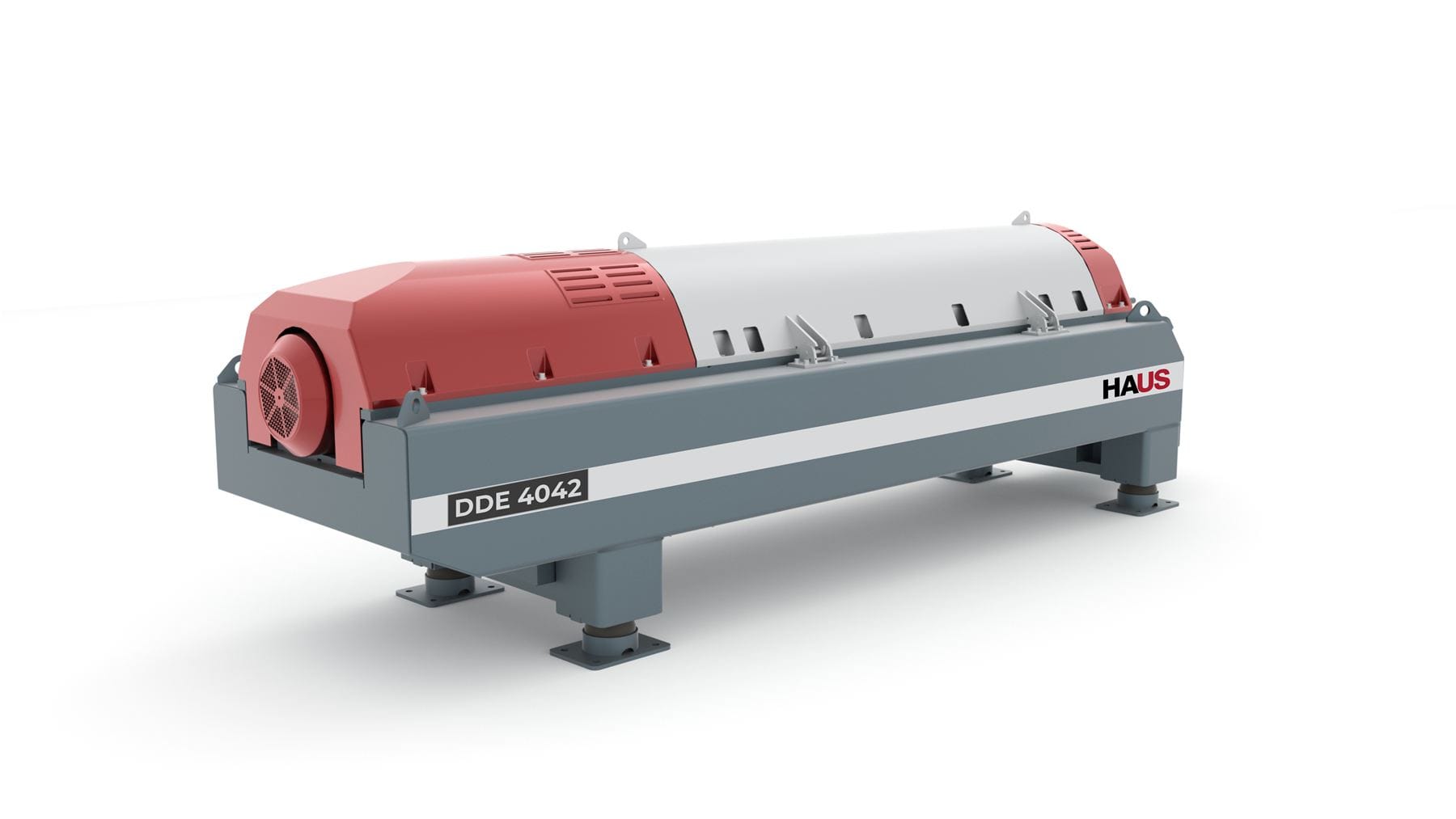
Walk-around of a HAUS decanter centrifuge: stainless centre cover over the bowl, red hoods over the drive and solids ends, main drive motor and frame.
The HAUS decanter range, from the DDE 2342 to the DDE 8242.
Technical Information
Bowl Material: Centrifugally Cast Duplex Stainless Steel 1.4462
Scroll Body Material: Stainless Steel AISI 316
Protection on Flights Against Wear: Flame sprayed Tungsten Carbide Coating
Gearbox Type: Sumitomo Cyclo
Frame material: Carbon Steel St37
Paint: Epoxy Paint (Primer 25-35 um, 2nd coat 40-60 um and final coat 40-60 um)
One bowl, one scroll, two speeds
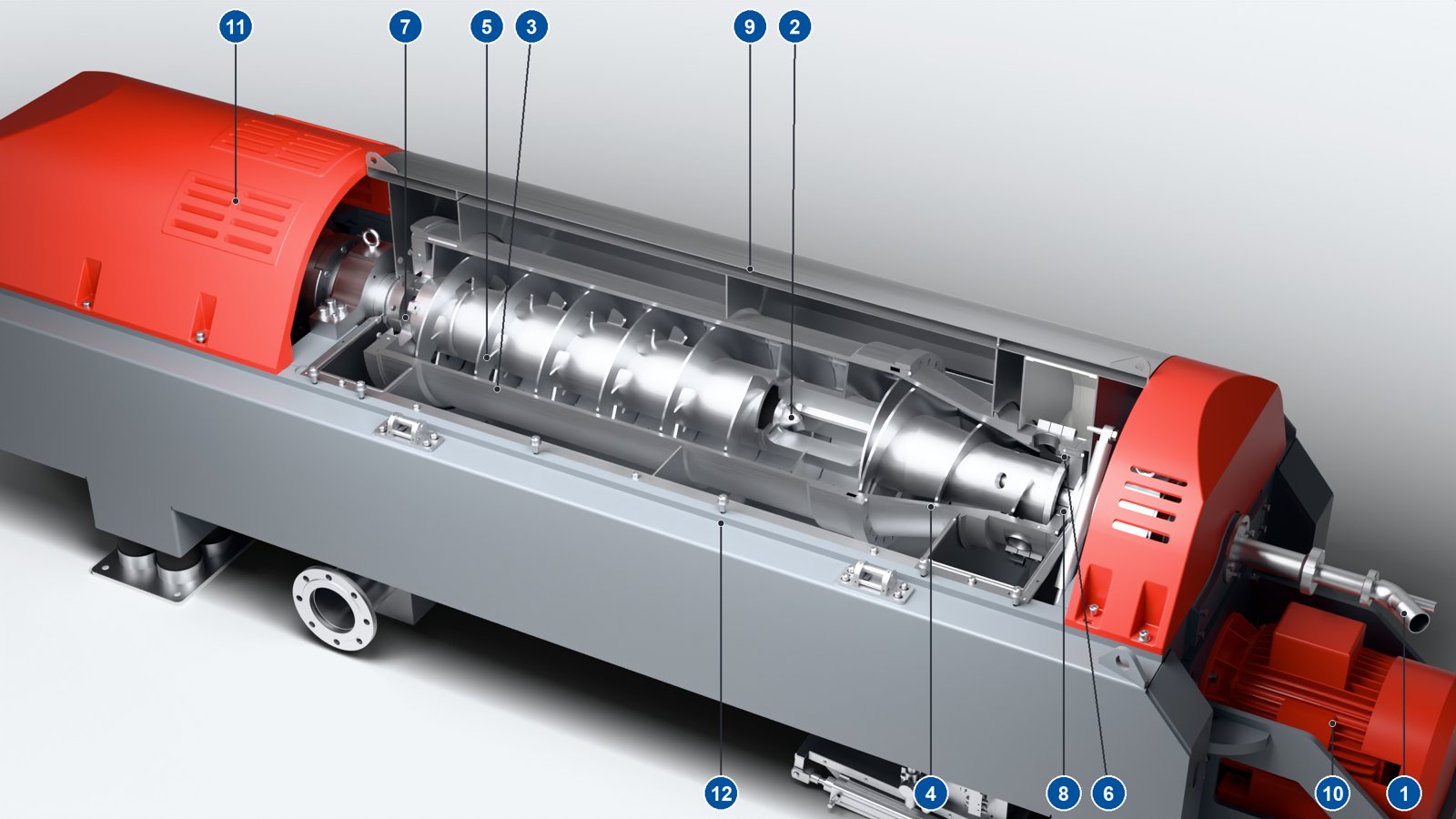
- Feed tube
- Feed zone and accelerator
- Bowl, cylindrical section
- Conical beach
- Scroll conveyor
- Wear protection (tungsten carbide)
- Liquid discharge weirs
- Solids discharge ports
- Stainless cover
- Main drive motor
- Gearbox and back-drive (under the hood)
- Frame
Gearbox
The Sumitomo Cyclo gearbox sets the differential speed between bowl and scroll.
Pond
Clarified liquid flows back along the bowl and leaves over plates that set the liquid level.
Scroll
Stainless steel AISI 316 scroll body; flights protected with flame-sprayed tungsten carbide.
Conical beach
The scroll carries the settled cake up the cone and out of the liquid to the cake outlet.
From feed to cake
Feed
The product is fed along the centre line to a fixed distribution room within the bowl.
Acceleration
It is accelerated into the bowl, rotating at high speed, by centrifugal force.
Settling
Centrifugal force makes the suspended solids (the cake) settle at the bowl wall.
Discharge
The scroll carries the cake out of the conical end; clarified liquid leaves the cylindrical end.
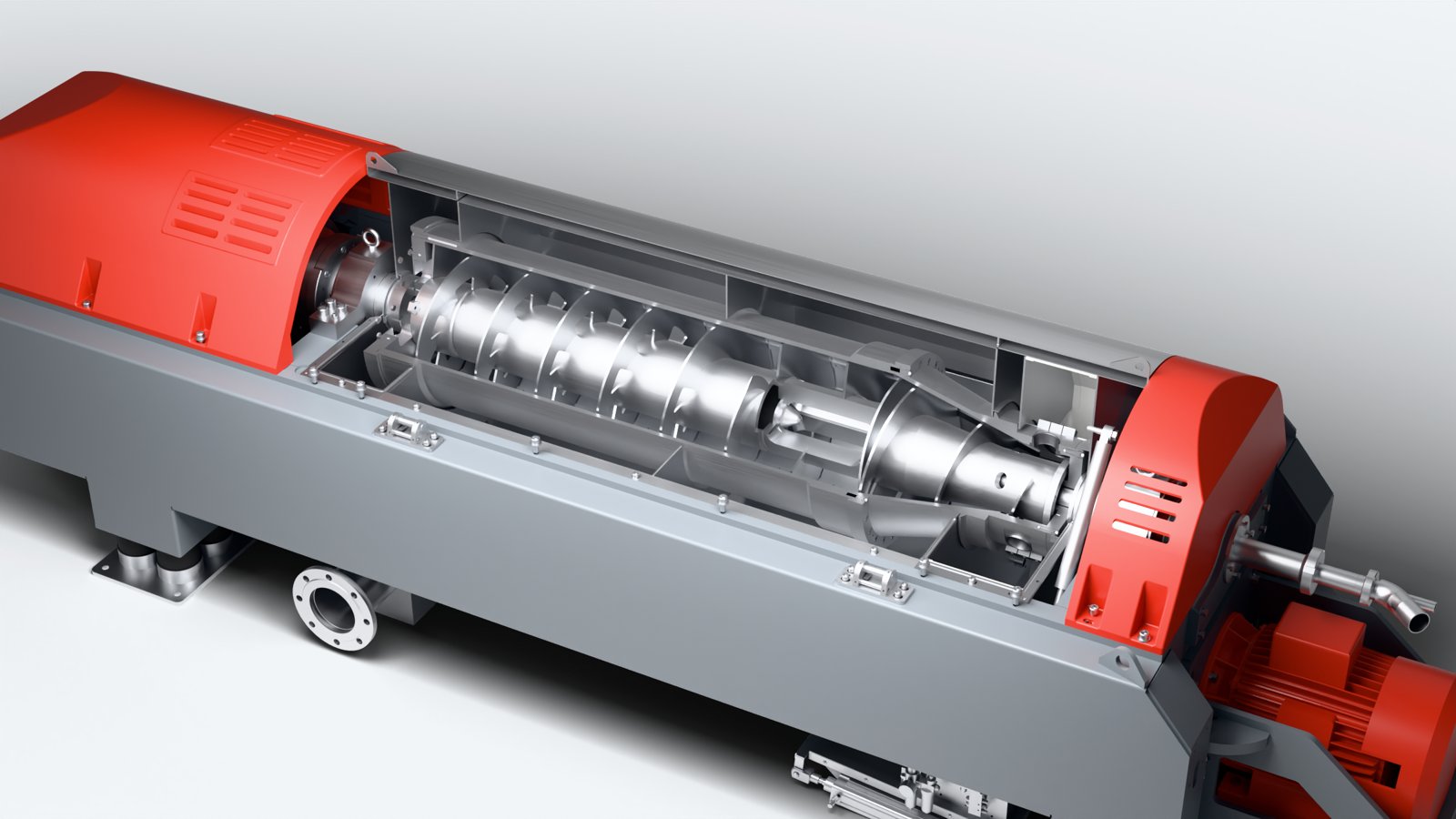
Built for clean separation
- Feed zone. The feed enters a chamber in the scroll hub and leaves through three wear-plated ports, ahead of the baffle disc.
- Bullnose feed accelerator. Turns the incoming feed outward and brings it up to rotating speed.
- Baffle disc. Holds back the clarified liquid at the start of the cone while dewatered solids pass under it.
- Quasi-axial flow windows. Openings at the root of the flights let liquid flow straight to the outlet.
Decanter centrifuge sizes for sludge dewatering
The HAUS DDE decanters are built for municipal and industrial wastewater and water treatment sludge. All product-contact parts are AISI 316 or duplex stainless steel, and every machine has a dual drive (separate bowl and scroll motors on frequency drives), so bowl speed and differential speed can be set independently while it runs.
| Model | Bowl diameter (mm) | Max. G | Main drive (kW) | Biological sludge (m³/h) | Dry solids load (kg/h) |
|---|---|---|---|---|---|
| DDE 2342 PDF: EN · FR | 238 | 3,575 | 7.5 | 2 – 5 | 60 – 160 |
| DDE 3042 PDF: EN · FR | 300 | 2,940 | 15 | 3 – 6* | 90 – 180* |
| DDE 3542 PDF: EN · FR | 353 | 3,460 | 18.5 / 22 | 6 – 15 | 250 – 500 |
| DDE 4042 PDF: EN · FR | 400 | 3,555 | 30 | 15 – 25 | 350 – 750 |
| DDE 4742 PDF: EN · FR | 470 | 3,020 | 37 | 20 – 35 | 500 – 1,000 |
| DDE 5342 PDF: EN · FR | 536 | 3,050 | 45 / 55 / 75 | 15 – 60 | 600 – 1,800 |
| DDE 6642 PDF: EN · FR | 660 | 2,874 | 90 | 30 – 85* | 900 – 2,500* |
| DDE 8242 PDF: EN · FR | 820 | 3,000 | 132 / 160 | 50 – 150 | 900 – 4,000 |
Each datasheet (two pages, in English or French) gives the technical data, the North American package and a dimensioned drawing. Max. G is the G-force at the maximum bowl speed in the HAUS manual. Capacities are guide values from HAUS for dewatering biological sludge; actual capacity depends on the sludge and its conditioning. * Archer estimate from the bowl geometry at 20 to 22 seconds liquid residence time. The larger models also thicken waste activated sludge, up to 250 m³/h on the DDE 8242. Hygienic, gas-tight and hazardous-area versions are available.
HAUS DDI seriesIndustrial decanter centrifuges (HAUS DDI)
The HAUS DDI decanters are the industrial range: two- or three-phase machines for fats and oils, vegetable oil and protein extraction, starch and yeast, chemicals and pharmaceuticals, oil and gas and process water. Each has its own two-page datasheet in English and French.
| Model | Bowl diameter (mm) | Max. bowl speed | Main drive (kW) |
|---|---|---|---|
| DDI 2342 PDF: EN · FR | 238 | 5,200 rpm | 7.5 |
| DDI 3042 PDF: EN · FR | 300 | 4,200 rpm | 15 |
| DDI 3542 PDF: EN · FR | 353 | 4,200 rpm | 18.5 |
| DDI 4042 PDF: EN · FR | 400 | 4,000 rpm | 30 |
| DDI 4742 PDF: EN · FR | 470 | 3,400 rpm | 37 |
| DDI 5342 PDF: EN · FR | 536 | 3,200 rpm | 55 |
| DDI 6642 PDF: EN · FR | 660 | 2,800 rpm | 75 |
From sludge volume to machine size
A plant produces 120 m³ a day of digested sludge at 3 % solids: 120 × 30 kg/m³ = 3,600 kg of dry solids a day. Dewatered over 12 hours a day, that is 300 kg/h at about 10 m³/h, which fits a DDE 3542 (250 to 500 kg/h, 6 to 15 m³/h). Running only 6 hours a day doubles the hourly load to 600 kg/h at 20 m³/h and calls for a DDE 4742. A second machine as standby, or a larger machine running fewer hours, are the usual choices to make next.
Decanters at work on municipal plants
Southern Alberta WWTP
HAUS DDE 4042 with an Archer control panel: 17.5 m³/h, 23 % cake.
BC coast WWTP
Two DDE 3532 decanters, duty and standby, on digested sludge.
Okanagan WWTP
A skid-mounted DDE 2342 dewaters biosolids on site.
Okanagan WTP
Two DDE 4042 decanters on water treatment residuals: 18 % cake, 95 % capture.
Try a decanter on your own sludge
Our containerized rental and demonstration unit carries a HAUS decanter, an inline polymer system and its own control panel. It is set up at your plant for a trial before you buy, or for temporary dewatering during a clean-out, an upgrade or a breakdown.
See how it started: Archer’s mobile dewatering unit.
From the first test to the spare parts
- Sludge and polymer testing in our lab
- Machine sizing and process design
- Skid or container package with feed pump, polymer system and cake conveyor
- Control panels, including hazardous areas
- Installation support, start-up and operator training
- Parts, field service and remote monitoring
Decanter centrifuge questions
What size of decanter centrifuge do I need?
Size starts from the dry solids you must remove per day and the hours you want to run. Sludge volume per day times solids concentration gives kilograms of dry solids; divide by the operating hours to get the solids load per hour and compare it with the table above. The hydraulic flow (m³/h) has to fit as well. We confirm the choice with a test on your sludge.
How dry will the cake be?
That depends mostly on the sludge: digested, waste activated, primary, water treatment residuals or industrial solids all behave differently. Bowl speed, differential speed, pond depth and polymer dose are then tuned on site. We give a cake dryness and solids capture you can rely on after testing your sludge; our case studies show what plants like yours achieve.
Can we try a decanter before buying one?
Yes. Our containerized rental and demonstration unit can be set up at your plant for a trial or for temporary dewatering, for example during a digester clean-out or while a permanent machine is being installed.
Decanter centrifuge or screw press?
A decanter handles higher flows in a small footprint, copes well with changing sludge and usually gives a drier cake; a multi-disc screw press runs slowly with very low power and noise, which suits small plants. We supply both and will tell you which fits your plant.
Who services HAUS decanters in Canada?
We do. Archer Separation supplies HAUS spare parts and wear parts, carries out field service, gearbox and bearing work and scroll and bowl inspections, and can add remote monitoring so problems show up before the machine stops.
Want the detail behind it? Read our decanter centrifuge guide: how it works, two-phase and three-phase machines, operating variables and troubleshooting.
Hygienic and gas-tight designs
HAUS builds decanters for more than sludge. The same machine family comes in versions for food-grade and closed processes.
Hygienic decanters
For juice, food and dairy: stainless product-contact parts and a hygienic design that is cleaned in place. HAUS also supplies hygienic disk-stack separators for the same industries.
Gas-tight decanters
Selected models are offered gas-tight, sealed for odorous, volatile or solvent-bearing process streams.
Hazardous areas
We supply decanter packages and control panels for classified areas, for example a Class I, Division 2 centrifuge room, with the panel in the safe area and rated devices at the machine.
More applications: Oil sludge and slop oil recovery · Fish meal, fish oil and stickwater · Ethanol stillage separation · Mining tailings and process water