
Decanter Centrifuge Guide
How a decanter centrifuge works, what each setting does, and how to run one well: a practical guide for engineers and operators.
A decanter centrifuge separates solids from liquid continuously, using thousands of times the force of gravity. This guide explains the machine, the handful of settings that decide cake dryness and centrate clarity, how polymer fits in, and what operators check every day. It draws on the HAUS training programme and on Archer’s own commissioning and service work.
On this page
How a decanter centrifuge works
A decanter is a long, solid-walled bowl that spins on a horizontal axis. Inside it a screw conveyor, the scroll, turns in the same direction but slightly faster or slower. A gearbox (or a second motor) sets that small speed difference, the differential speed. The bowl has a cylindrical section, where most of the separation happens, and a conical section, the beach, where the solids are lifted out of the liquid and drained.
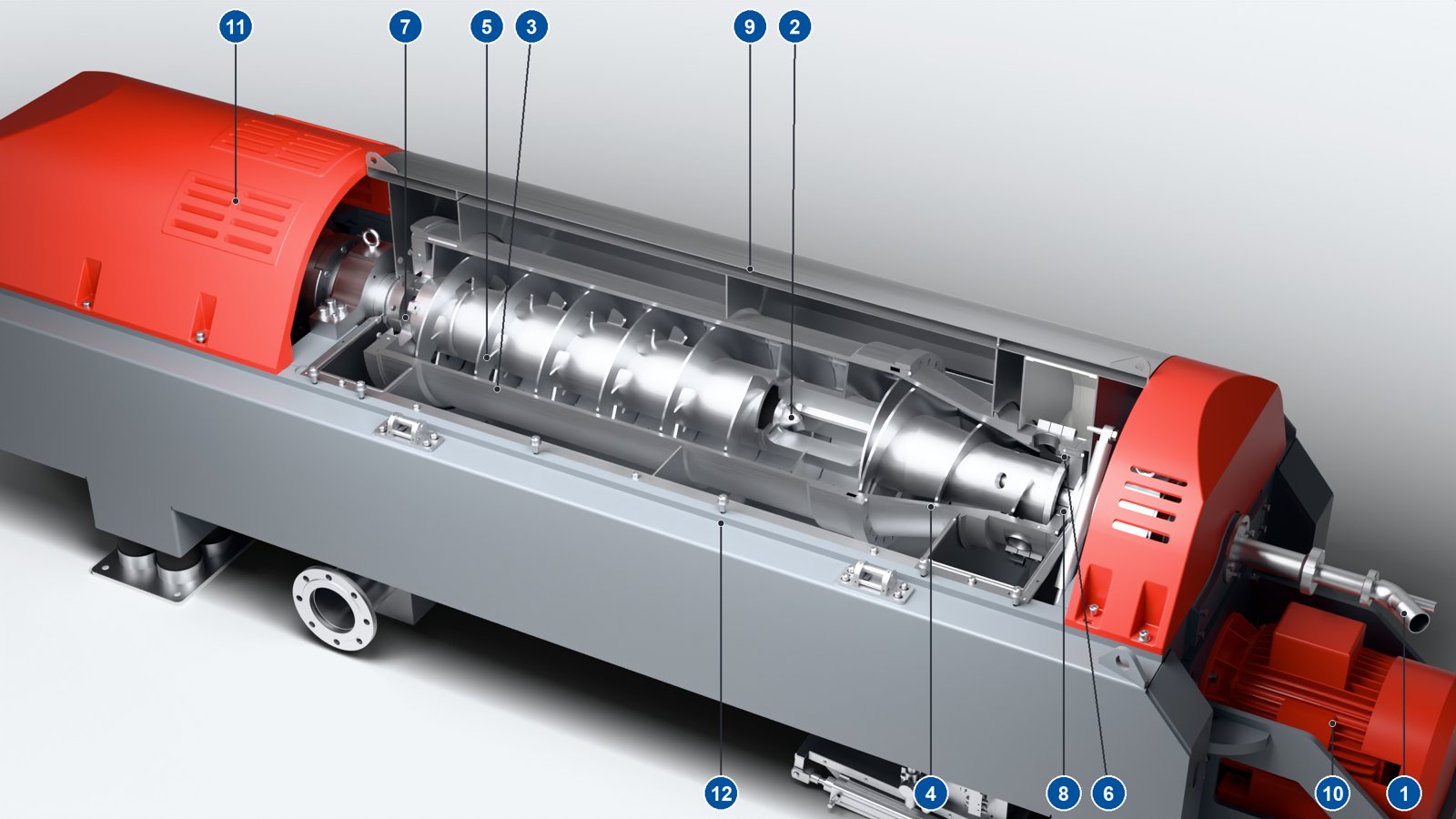
- Feed tube
- Feed zone and accelerator
- Bowl, cylindrical section
- Conical beach
- Scroll conveyor
- Wear protection (tungsten carbide)
- Liquid discharge weirs
- Solids discharge ports
- Stainless cover
- Main drive motor
- Gearbox and back-drive (under the hood)
- Frame
Feed
The feed enters through a stationary pipe on the centre line and is released into a feed chamber in the scroll hub, which brings it up to bowl speed.
Settle
Centrifugal force throws the heavier solids against the bowl wall. The liquid forms a ring inside them: the pond.
Convey
Because the scroll turns at a slightly different speed, its flights push the settled solids along the wall, up the beach and out of the pond.
Discharge
Cake leaves through ports at the narrow end of the cone. Clarified liquid, the centrate, flows the other way and spills over weir plates at the large end.
G-force
Settling that takes hours in a tank takes seconds in a decanter. HAUS training material puts a typical decanter at around 3,000 times gravity. The force depends on bowl diameter and speed:
| G-force (approx.) | rpm² × bowl inside diameter in mm ÷ 1,790,000 |
|---|---|
| Worked example | A 470 mm bowl at 3,000 rpm gives about 2,400 g |
Never exceed the maximum bowl speed on the machine nameplate and in the manual; it is set by the bowl design and the density of the feed.
Pond depth and weir plates
The liquid level in the bowl is set by the radius of the weir plates (also called dam or level plates) on the liquid discharge end. A smaller weir radius makes a deeper pond: the liquid stays in the bowl longer and the centrate is clearer, but less of the beach is above the liquid to drain the cake. A larger radius makes a shallower pond and a longer dry beach, which favours a drier cake. HAUS environment decanters allow positive, neutral or negative pond settings, so the machine can be matched to soft, hard-to-convey sludge or to easily drained solids. Weir plates are changed with the machine stopped and locked out, and all plates on a bowl must be set to the same level.
The beach
On the cone, the scroll lifts the cake out of the pond. Here the liquid drains back and the cake is compacted before it is discharged. Beach angle and length are part of the machine design (HAUS offers 8.5° to 20° cones), chosen for how easily the solids drain and slide.
Built to last
On HAUS decanters the bowl is centrifugally cast duplex stainless steel and the scroll is stainless steel with tungsten carbide wear protection on the flights, feed zone and solids outlet. For abrasive feeds the wear package can be upgraded to sintered tungsten carbide tiles. See Decanter Centrifuges for the full specification.
Two-phase and three-phase decanters
Two-phase
Separates solids from one liquid. This is the machine for sludge dewatering and thickening, water treatment residuals, manure, plastics wash water and most industrial dewatering.
Three-phase
Separates solids and two liquids of different density, typically water and oil or fat. The heavy liquid leaves over the weir plates; the light liquid leaves through a separate, adjustable outlet. Used in olive oil extraction and rendering.
Reading a HAUS model code
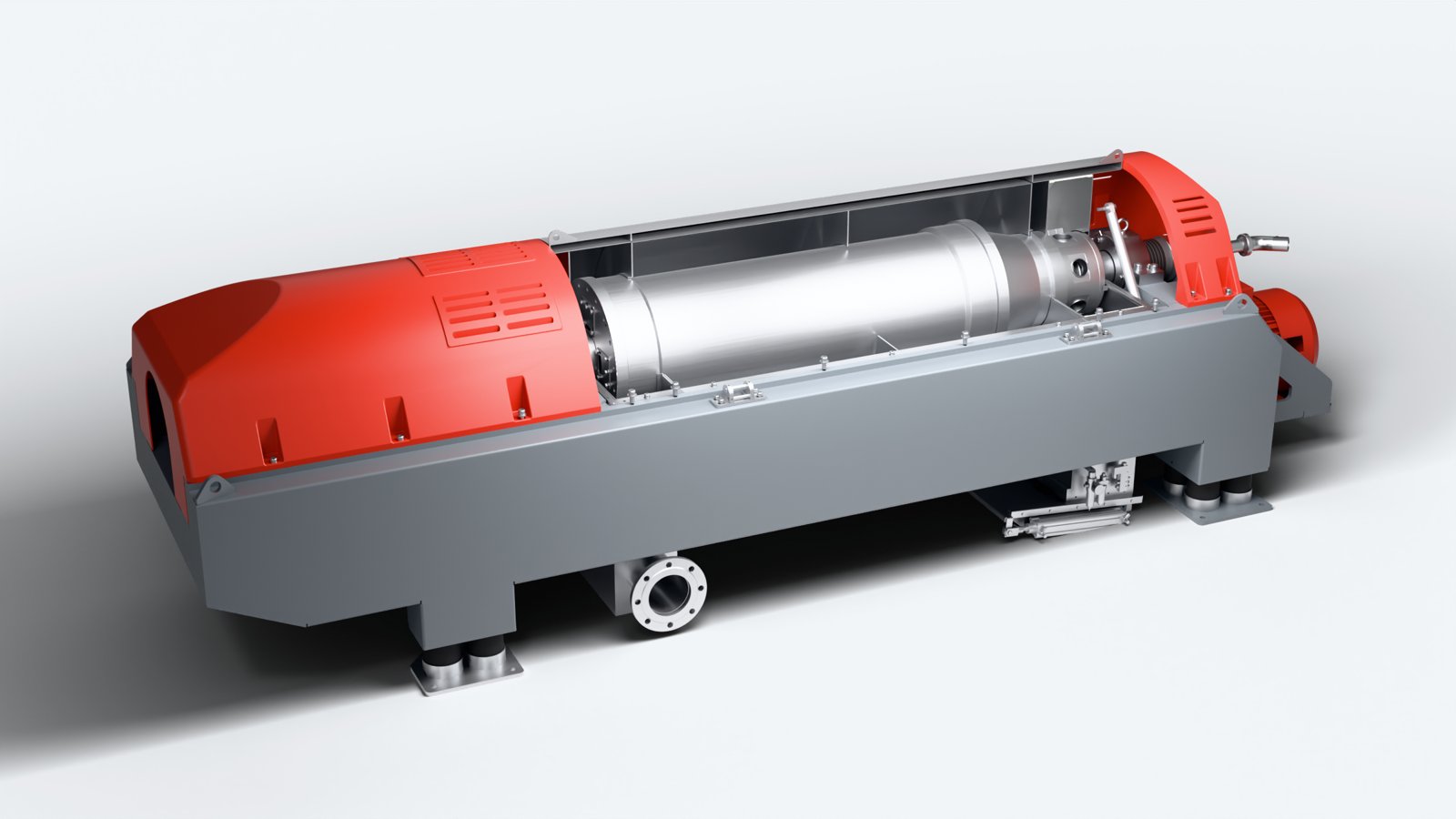
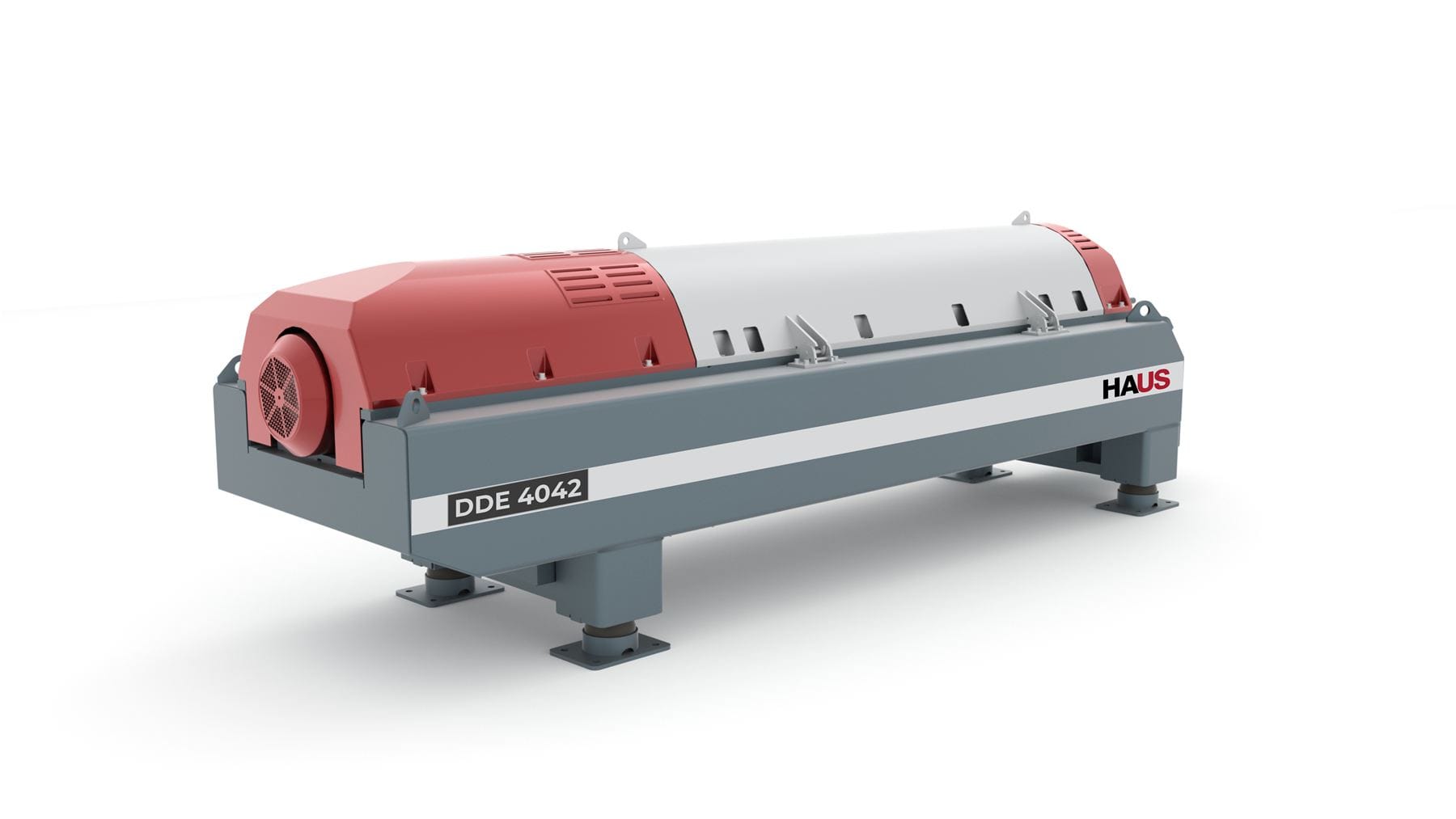
The model code tells you the machine. In DDE 4742: D for decanter, D for dual drive (bowl and scroll each on their own motor and drive), E for the environment range; 47 is the bowl inside diameter (470 mm), 4 the length-to-diameter ratio, and the last digit the number of phases (2). A DDI 4743 would be the three-phase industrial version.
Operating variables: cake dryness and centrate clarity
Every decanter setting is a trade-off between a drier cake, a cleaner centrate and more throughput. Change one thing at a time, give the machine a few minutes to settle, and sample both the cake and the centrate before the next change.
| Variable | Cake dryness | Centrate clarity | Watch out for |
|---|---|---|---|
| Feed rate | Higher feed: wetter cake | Higher feed: shorter time in the bowl, more solids in the centrate | The hydraulic and solids limits of the machine |
| Feed solids | A sudden rise loads the scroll and can wet the cake | Can drop if the polymer dose does not follow the solids load | Torque spikes; pace polymer on solids load, not only flow |
| Differential speed | Lower: cake stays longer in the bowl, drier cake | Too low: solids build up and spill into the centrate | Rising torque; most dual-drive panels can hold torque by trimming the differential automatically |
| Pond depth (weir radius) | Shallower pond, longer dry beach: drier cake | Deeper pond: clearer centrate | Only changed with the machine stopped; all plates the same |
| Bowl speed (G-force) | Higher: drier cake | Higher: clearer centrate | Power, wear and noise rise; never exceed nameplate speed |
| Polymer dose | Right dose: firm, well-drained cake; overdose: sticky, slimy cake | Underdose: cloudy centrate; overdose can also foul it | Polymer is often the largest running cost |
| Feed temperature | Warmer feed usually dewaters better | Warmer feed usually separates better | The temperature limit of the machine and seals |
Finding the right differential
Centrate clarity is the quickest guide. While the centrate stays clear, lower the differential in small steps to dry the cake. When the centrate starts to turn cloudy, or torque climbs towards its limit, go back one step: that is the working point for this sludge and this polymer dose.
Two numbers that matter
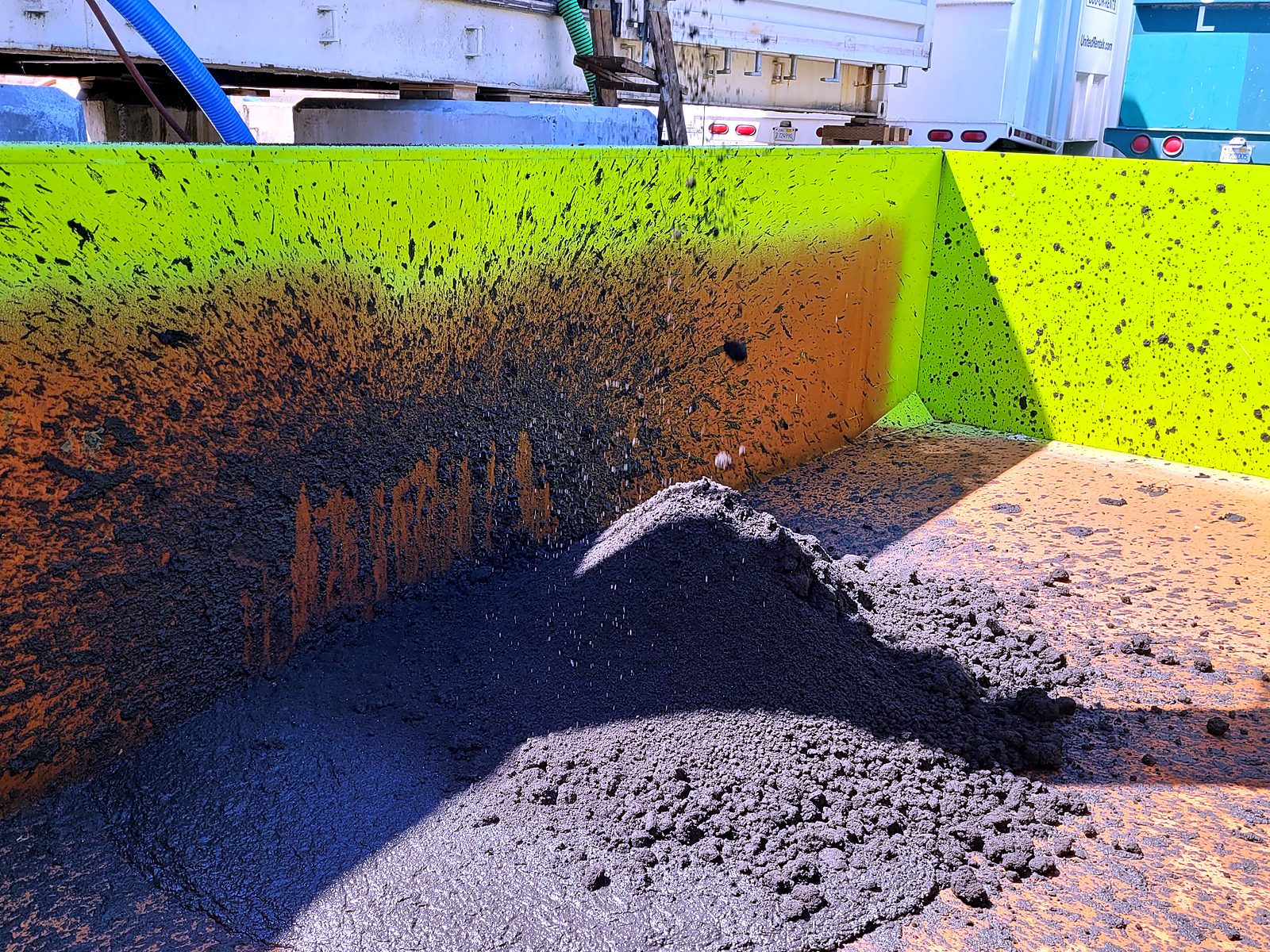
Cake dryness (% dry solids) sets hauling and disposal cost. Solids capture (the share of feed solids that leave in the cake) sets how much load goes back to the plant with the centrate. Track both. On municipal sludge, Archer-supported decanters in British Columbia and Alberta produce cake above 20 % dry solids with more than 95 % solids capture; what your plant achieves depends on the sludge.
Polymer conditioning basics
Most biological and fine sludges need a flocculant, usually a cationic polyacrylamide, to dewater well. The polymer bridges the fine particles into larger, stronger flocs that settle quickly in the bowl and release their water on the beach.
Choose the product
Charge and molecular weight are matched to the sludge by beaker tests and then confirmed on the running machine. Archer provides polymer testing and selection, and records results in JarLab.
Make it down properly
Powder or emulsion polymer is mixed with water and given time to uncoil (mature) before use; typical make-down strengths are a few tenths of a percent. A polymer system does this automatically.
Dose it in the right place
Polymer is usually diluted further and injected into the feed line close to the decanter. Trying more than one injection point is often the cheapest way to cut polymer use.
Mixing energy matters too: too little and the polymer forms gel lumps (“fish-eyes”) that never work; too much and the long chains are sheared and lose strength.
- Underdosed: cloudy centrate, poor capture, wet cake.
- Overdosed: sticky, slimy cake, foaming centrate and wasted money.
- Right dose: firm cake and centrate that stays clear when the dose is trimmed slightly; find the lowest dose that holds capture.
Advantages of decanter centrifuges
Several technologies can dewater sludge: decanter centrifuges, screw presses, belt presses and drying beds among them. Each has its place. A decanter is a strong choice when:
It runs continuously
Feed in, cake and centrate out, around the clock, with no batches to empty and refill.
Space is tight
High throughput from a compact, enclosed machine; a complete plant even fits in a shipping container.
Odour and hygiene matter
The process is enclosed, so odours and aerosols stay inside the casing, and there are no open belts to wash.
The feed changes
Differential speed and pond depth can be adjusted to follow a changing sludge, and the control panel can do it automatically.
Little supervision is wanted
Automatic control, low wash-water use and remote monitoring let a decanter run unattended for long periods.
Three products are needed
Only a three-phase decanter separates solids, water and oil in one continuous step.
The trade-offs are higher power use than a low-speed press, and a high-speed machine that needs trained maintenance and attention to wear in abrasive service. For smaller or low-energy duties a multi-disc screw press may suit better; Archer supplies both and will recommend the one that fits.
Applications
Archer has applied decanters to municipal, food and industrial separation and dewatering across Canada and the United States.
- Municipal wastewater treatment: primary, secondary and digested sludge
- Sludge dewatering: municipal and industrial sludges, DAF float and water treatment residuals
- Meat processing and rendering: fat, protein and solids recovery
- Olive oil extraction: three-phase separation of oil, water and pomace
- Potato processing: starch recovery from process water
- Plant-based milk: removing insoluble fibre
- Plastic recycling and PVC dewatering
- Dairy manure, manure pit water and cattle paunch
Generic flowsheet for illustration. Every Archer system is designed to its own basis; ask us for one drawn for your plant.
See more in Industries and applications and our case studies.
Operator training
This section is a general overview. Always follow the manufacturer’s manual for your machine and your site’s lockout and safety procedures; only trained, authorized people should operate or open a decanter.
Start-up sequence
Check
Guards and covers closed, mountings and anti-vibration pads sound, belts tensioned, lubrication done, sensors in place, discharge chutes and conveyors clear.
Run up
Start the bowl and scroll drives from the panel in automatic, confirm the direction of rotation and let the bowl reach speed and run empty for the warm-up time in the manual.
Feed
Start the polymer system and the feed pump at a reduced rate, then raise the feed in steps while watching torque.
Confirm
Check the cake and the centrate, and read torque, both main bearing temperatures and vibration on the screen before leaving the machine.
Shutdown sequence
Stop the feed
Stop the feed pump and the polymer dosing.
Flush
Run the wash cycle with water at speed until the centrate runs clear, so no solids are left to dry in the bowl.
Run down
Stop the bowl and let the panel run the scroll through the coast-down; never try to brake the bowl by hand.
Secure
Isolate and lock out before opening covers. Clean lubricant residues and record the run in the logbook.
If something sounds or feels wrong
The first action for any malfunction is to stop the feed and start the wash. If noise or vibration is clearly different from normal, shut the machine down; use the emergency stop if needed. Call for service before restarting.
Daily checks
Process
- Centrate: clear, no floating flocs or foam
- Cake: firm, consistent, not slimy
- Feed flow, polymer flow and make-down strength
- Polymer and feed tank levels
- Samples for cake % dry solids and centrate solids
Machine
- Torque, bearing temperatures and vibration against their normal trend
- Unusual noise from the drives or bearings
- Leaks at the feed pipe, seals and chutes
- Lubrication as scheduled, belts and guards
- Alarms reviewed and the logbook filled in
Preventive maintenance
- Keep feed rate, feed solids and bowl speed within the design the machine was selected for.
- Weekly to monthly: open the casing (locked out) and remove any solids build-up.
- At the intervals in the manual: check gearbox oil, belt tension and wear on the scroll flights and solids outlet.
- Test vibration and temperature shut-offs and other protective devices periodically.
- Use only the approved greases and oils, within their shelf life, and genuine spare parts; keep service kits in stock.
- Trend vibration and bearing temperatures so wear shows up long before a failure; our remote monitoring does this for you.
Troubleshooting
| Symptom | Likely cause | What to do |
|---|---|---|
| Cloudy centrate | Polymer underdosed or wrong product; feed rate too high; pond too shallow; differential so low that solids spill over | Check polymer make-down and dose; reduce feed; raise the differential; consider deeper-pond weir plates |
| Wet cake | Differential too high; pond too deep; feed too high or feed solids up; bowl speed too low; feed pipe position (if adjustable) | Lower the differential in small steps; reduce feed or dose to the solids load; check bowl speed and feed pipe setting |
| High torque or torque trips | Feed solids surge; differential too low; overdosed, sticky cake | Reduce feed; raise the differential; correct the polymer dose; if the machine trips, stop feed and wash for 15 to 30 minutes |
| Rising vibration | Solids deposited unevenly in the bowl; wear on the scroll or bearings; loose mounting | Stop feed and wash; check mountings; if it persists, stop and call service |
| High bearing temperature | Too little, too much or the wrong grease; bearing damage | Grease to the manual’s schedule and grade; call service if the temperature keeps rising |
| Slow to reach speed | Low supply voltage; motor fault; solids stuck between bowl and scroll | Check supply and drive alarms; wash the casing and bowl |
| Noise from the drives | Lubrication missing; belts slack or worn; bearing damage | Lubricate; check belt tension; call service for bearing noise |
| Foam in the centrate | Polymer overdose; air drawn into the feed | Trim the polymer dose; check the feed pump suction and tank level |
Based in part on the HAUS environment decanter manual troubleshooting guide. Persistent faults, bearing noise and high vibration need a qualified service technician.
Glossary
| Beach | The conical end of the bowl, where cake is lifted out of the pond and drains. |
|---|---|
| Bowl | The rotating, solid-walled drum in which separation takes place. |
| Cake | The dewatered solids discharged at the conical end. |
| Centrate | The clarified liquid discharged over the weir plates. |
| Differential speed | The difference in rpm between bowl and scroll; it sets how fast solids are conveyed out. |
| Dry solids (DS) | The mass of solids left after drying, as a percentage of the wet cake. |
| Dual drive | Separate motors and drives for the bowl and the scroll, so the differential can be changed while running. |
| G-force | Centrifugal acceleration as a multiple of gravity. |
| L/D ratio | Bowl length divided by bowl diameter; longer bowls give more time for clarification. |
| Polymer | A long-chain flocculant that bridges fine particles into flocs that separate easily. |
| Pond depth | The depth of the liquid ring in the bowl, set by the weir plates. |
| Scroll | The screw conveyor inside the bowl that moves settled solids to the cake outlet. |
| Solids capture | The share of feed solids that leave in the cake rather than the centrate. |
| Three-phase | A decanter that separates solids and two liquids, such as water and oil. |
| Torque | The load on the scroll drive; a direct measure of how much solids the scroll is moving. |
| Weir plates | Plates on the liquid end of the bowl that set the pond depth. |
Ask about operator training for your plant
Archer’s engineers are on site for start-up, commissioning and operator training on the systems we supply, and help optimize process control once the plant is running. At close-out the standard operating procedures and training documents are updated to “as commissioned”, so your crew trains on the plant they actually run. After that we stay on call for troubleshooting, polymer testing and selection, and preventive maintenance.
Related pages
- Decanter Centrifuges: HAUS decanters supplied by Archer
- Dissolved Air Flotation (DAF) Guide: the other half of many food and industrial plants
- Polymer Systems: make-down and dosing for dewatering
- Containerized Centrifuge Systems: a complete dewatering plant in a container
- Remote Monitoring: torque, vibration and bearing trends watched by our engineers
- Resources: all Archer guides
Have a sludge or process stream you want to dewater? Send us a sample or your data and we will tell you what a decanter can do with it.