
Dissolved Air Flotation (DAF) Guide
How dissolved air flotation works, the chemistry and settings behind a clear effluent, and how to run a DAF day to day.
Dissolved air flotation (DAF) lifts fats, oils, grease and light suspended solids to the surface with millions of micro-bubbles, where a skimmer removes them as float. This guide covers the principle, the chemistry, the key design and operating parameters, how a DAF works with a decanter centrifuge, and what operators check every shift.
On this page
How dissolved air flotation works
Many of the solids in industrial wastewater are almost as light as water, or lighter: fat, oil, protein, fibre and fine floc. They settle slowly, if at all. DAF does the opposite of a settling tank: it attaches fine air bubbles to the particles until they are lighter than water, and lets them rise.
Saturation
Part of the clarified effluent is pumped back as recycle and pressurized, typically to 4 to 6 bar, with air. Under pressure, much more air dissolves in the water.
Release
The saturated recycle, often called whitewater, is let down to atmospheric pressure through a release valve or nozzles at the tank inlet. The air comes out of solution as micro-bubbles, typically 10 to 100 µm.
Attachment
In the contact zone the bubbles meet the flocculated feed and attach to or get trapped in the flocs, forming bubble-floc aggregates.
Separation
The aggregates rise to form a float blanket that the skimmer pushes into the float hopper. Clarified water leaves from the bottom; heavy solids that settle are drawn off separately.

Inside the tank
- Contact zone: behind an inclined baffle, where flocculated water and whitewater mix and bubbles attach.
- Separation zone: where aggregates rise and clarified water flows down to the outlet; some DAFs add inclined plates to increase the effective area.
- Float and skimmer: the float layer drains and thickens before the scraper removes it.
- Bottom sludge: grit and heavy solids collected in a hopper or by a bottom scraper and drained periodically.
- Level control: an adjustable effluent weir sets the water level, and with it how much float the skimmer takes.
DAF chemistry: coagulant, polymer and pH
Air alone floats only a fraction of the solids. Good DAF performance comes from chemistry that turns fine, stable particles and emulsified fat into strong flocs that bubbles can hold.
Coagulant
A metal salt (iron or aluminium) or an organic coagulant neutralizes the charge on fine particles and breaks emulsions so they can come together.
pH
Each coagulant works best in a pH window; in some protein-rich wastewaters a low pH helps precipitate proteins. Acid or caustic is dosed under pH control.
Polymer
A flocculant polymer, added last, bridges the small particles into large, tough flocs that hold air and do not break up in the tank.
Chemicals are usually added in a pipe flocculator ahead of the DAF: a run of pipe with static mixers and injection points for coagulant, pH correction and polymer, giving each chemical the right mixing and reaction time before the tank.
Dose to the water, not the worst case
The dose-response is a U-curve. Too little chemical and solids carry over into the effluent; too much and the floc restabilizes, carry-over rises again, and the chemical bill with it. Jar tests set the starting programme, and JarLab keeps the results. On line, the Archer IIoT Gateway paces polymer on the incoming solids load, trims it on effluent TSS, and confirms every dose with a flowmeter on each chemical line.

Key design and operating parameters
The values below are typical ranges from published design guidance and Archer practice, for orientation only. Every wastewater is different: an Archer DAF is sized from your flows and loads, and ideally from jar or pilot tests.
| Parameter | Typical range | What it does |
|---|---|---|
| Hydraulic loading rate (flow ÷ flotation area) | Industrial wastewater: about 1 to 5 m/h (0.5 to 2 gpm/ft²); drinking water: 5 to 15 m/h and higher; plate-pack DAFs higher still per unit of footprint | Sets the tank size; too high and aggregates are carried out with the effluent |
| Air-to-solids ratio (mass of air ÷ mass of feed solids) | About 0.005 to 0.06 kg/kg; lower end where feed TSS is below about 2,000 mg/L | Too little air and solids sink or carry over; too much wastes energy and can disturb the float |
| Recycle rate (% of feed flow) | About 15 to 50 % for industrial wastewater (published range 5 to 120 %); about 8 to 12 % in drinking water | The main way an operator adjusts the air supplied |
| Saturator pressure | About 4 to 6 bar (60 to 85 psig) | Higher pressure dissolves more air and gives finer bubbles |
| Flocculation time | About 5 to 10 minutes in tanks; less in a pipe flocculator | Gives the polymer time to build flocs before the tank |
| Bubble size | About 10 to 100 µm | Fine bubbles attach well and rise gently; large bubbles break flocs |
| Float solids | Typically a few percent dry solids, depending on the solids and the skimmer setting | Thicker float means less volume to haul or dewater |
Sources: published DAF design manuals and reviews (WEF, Metcalf & Eddy, Edzwald) and Archer project experience. Ranges, not design values.
Advantages over settling clarifiers
Gravity clarifiers and lamella separators remain the right tool for dense, fast-settling solids, and Archer supplies lamella separators for that duty. For light solids, DAF usually wins:
Removes what floats
Fats, oils and grease, protein, algae and low-density floc rise readily with air but settle poorly.
Smaller footprint
Higher loading rates than most settling processes mean a much smaller tank for the same flow.
Short detention
Flocculation and flotation take minutes, not hours, so less volume and faster response to changes.
Handles cold water and swings
Performs well with cold water and is less sensitive to flow variations than many settling processes.
Adjustable
Air, chemistry and skimming can all be tuned to suit the load.
Less chemical, less sludge
Often achieves the result at a lower coagulant dose, which means less chemical to store and less sludge to handle.
The trade-offs: a DAF needs a recycle pump and air supply, a chemical programme, and attention to the skimmer and float. Very heavy or gritty solids should be removed upstream by screening or settling.
Applications
- Meat and poultry processing: fat, blood and protein removal before discharge
- Food processing: vegetable, snack, beverage and canning wastewater
- Dairy: milk solids and fat in plant wastewater
- Fish and seafood processing, as in our fish processing case study
- Rendering: high-strength stick water and plant effluent
- Oily wastewater, often after a lamella separator
- Pulp and paper fibre recovery, textile and leather, sludge thickening and drinking-water clarification
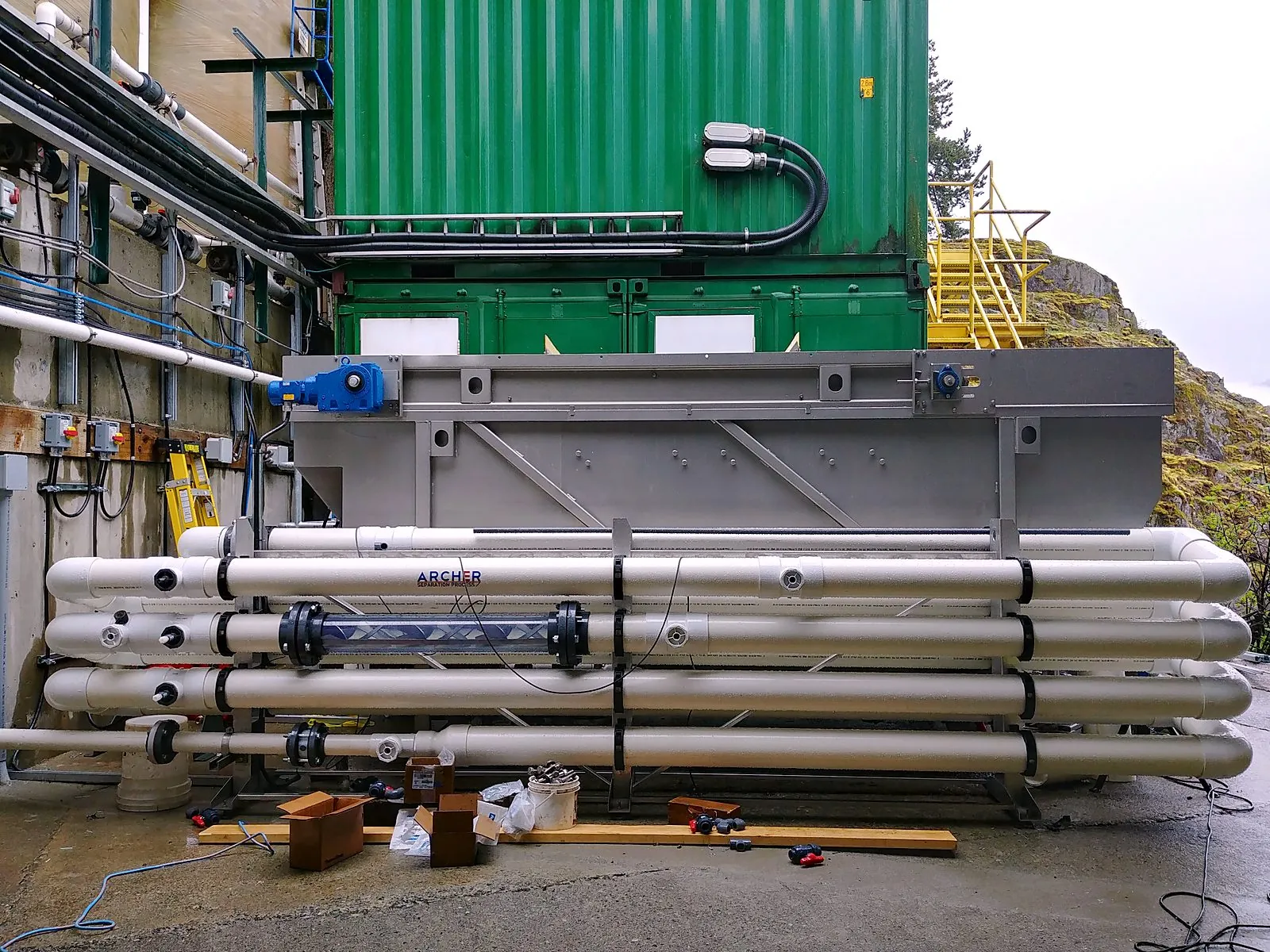
Archer supplies complete DAF systems, see DAF / Dissolved Air Flotation Systems and Sigma DAF Clarifiers, with the chemical and polymer systems that feed them.
DAF and decanter: dewatering the float
DAF float is wet, typically only a few percent solids, and expensive to haul as a liquid. A decanter centrifuge turns it into a cake that can be trucked, composted or rendered, and returns the centrate to the head of the DAF.
Generic flowsheet for illustration. Every Archer system is designed to its own basis; ask us for one drawn for your plant.
Float tank
Float is collected and mixed in a tank so the decanter sees a steady feed; heating fatty float can help release fat.
Polymer
A separate polymer dose, chosen for the float, conditions it ahead of the decanter.
Two- or three-phase
A two-phase decanter makes cake and centrate; a three-phase decanter can also recover fat or oil from fatty float.
Operator training
General guidance only. Follow the manufacturer’s manual for your DAF and your site’s safety and lockout procedures.
Daily checks
Chemistry
- pH at the coagulation and flocculation points
- Chemical tank levels and pump rates; confirm the actual draw-down
- Polymer make-down strength and appearance (no lumps)
- Floc appearance in the flocculator sight glass or sample
- A quick jar test whenever the wastewater changes
Flotation
- Whitewater milky and even across the tank; no large bubbles boiling at the surface
- Saturator pressure, air flow and recycle flow normal
- Float blanket firm, even and not breaking up
- Effluent clarity, plus a TSS or turbidity sample
- Skimmer, bottom sludge drain and float pump working; log readings
Float and skimmer settings
Water level
Set the effluent weir so the skimmer blades just bite into the float. Too high and the skimmer takes water; too low and float is left behind.
Skimmer interval
Let the float drain and thicken between passes, but not so long that it loses its air and starts to sink.
Skimmer speed
Run slowly enough to move the blanket without breaking it up or pushing float back under.
Bottom drain
Drain heavy solids from the bottom hopper often enough that they do not build up or turn septic.
Troubleshooting
| Symptom | Likely cause | What to do |
|---|---|---|
| Cloudy effluent, solids carry-over | Chemistry off (pH, coagulant or polymer dose); not enough air; flow above design | Check pH and chemical feed; run a jar test; check recycle flow and saturator pressure; reduce flow if overloaded |
| Large bubbles, boiling surface | Air not dissolving: saturator level or air flow wrong; release valve worn or blocked | Check the saturator level and air supply; inspect and clean the release valve or nozzles |
| Fine floc, poor float | Polymer underdosed, poorly made down or added at the wrong point; too little flocculation time | Check make-down strength and age; adjust dose; check the injection point and mixing |
| Float sinking or breaking up | Float left too long and degassing; skimmer too fast; overdosed, fragile floc | Skim more often or more slowly; trim polymer; check the air-to-solids ratio |
| Float too wet | Water level too high; skimmer runs too often | Lower the effluent weir slightly; lengthen the skimmer interval |
| Solids building up on the bottom | Heavy solids or grit in the feed; bottom drain too infrequent | Drain more often; improve screening or settling upstream |
| pH hunting or drifting | Fouled or uncalibrated probe; dosing loop poorly tuned | Clean and calibrate the probe; retune or use adaptive pH control |
| Rising chemical cost | Open-loop dosing set for the worst case | Pace dosing on load and trim on effluent quality |
Glossary
| Air-to-solids ratio | The mass of air released per mass of solids fed to the DAF. |
|---|---|
| Bottom sludge | Heavy solids that settle in the DAF instead of floating. |
| Coagulant | A chemical that neutralizes particle charge and breaks emulsions so particles can come together. |
| Contact zone | The inlet zone where flocculated water meets the whitewater and bubbles attach. |
| Float | The layer of floated solids, fat and air that the skimmer removes. |
| Flocculant (polymer) | A long-chain polymer that bridges small particles into large flocs. |
| FOG | Fats, oils and grease. |
| Hydraulic loading rate | Flow divided by flotation area, in m/h or gpm/ft². |
| Pipe flocculator | A pipe with static mixers and injection points where chemicals are added and mixed ahead of the DAF. |
| Recycle | The share of clarified effluent pressurized with air and returned to the tank. |
| Saturator | The pressure vessel or system in which air is dissolved in the recycle. |
| Skimmer | The scraper that pushes float into the float hopper. |
| TSS | Total suspended solids, the main measure of DAF performance. |
| Whitewater | Air-saturated recycle released into the tank; its milky look comes from the micro-bubbles. |
Ask about operator training for your plant
Archer’s engineers are on site for start-up, commissioning and operator training on the DAF and chemical systems we supply, and help optimize process control once the plant is running. At close-out the standard operating procedures and training documents are updated to “as commissioned”. After that we stay on call for troubleshooting, chemical and polymer testing and selection, and preventive maintenance.
Related pages
- DAF / Dissolved Air Flotation Systems: complete DAF systems from Archer
- Sigma DAF Clarifiers: DAF units for every flow range
- Decanter Centrifuge Guide: dewatering the float
- Remote Monitoring: the IIoT Gateway for DAF chemical dosing
- JarLab: jar tests and water analysis in one record
- Resources: all Archer guides
Planning a new DAF, or want more from the one you have? Send us your flows and a lab analysis and we will tell you what it takes.