
Disk Stack Centrifuges (Disc Stack Separators)
High-speed disc-stack separators that clarify liquids and split liquid phases in food, dairy, oil and industrial processes.
Archer Separation provides disk stack centrifuges for a wide range of industrial applications. A disc stack centrifuge is a high-speed machine that separates particles or liquids by density. A stack of conical discs inside the bowl creates a large separating surface, and at very high speed the centrifugal force drives denser particles toward the outer edge of the bowl while lighter liquids move toward the centre.
Generic flowsheet for illustration. Every Archer system is designed to its own basis; ask us for one drawn for your plant.
Here's how they work in detail
Centrifugal force
As the bowl spins, centrifugal force separates the components of the mixture by density. Denser substances (solids or heavier liquids) move out to the periphery; lighter components stay closer to the centre.
Disc stack design
The conical discs are stacked so the mixture flows through the narrow spaces between them. This multiplies the separating surface and gives the materials more room to separate before they reach the bowl wall.
Separation of phases
Disc stack centrifuges separate solid-liquid mixtures and liquid-liquid mixtures (such as oil-water emulsions), and clarify liquids by removing suspended particles.
A lamella settler, spun up
A gravity settler's capacity depends on its settling area and on how fast the particles settle. A lamella separator adds area with inclined plates; a disc stack centrifuge rolls those plates into cones and spins them at typically more than 5,000 g. Each particle only has to travel the short gap between two discs before it is caught, which is why disc stack machines can remove very fine particles at high throughput.
Bowls are built in three typical forms: solid-wall bowls that are cleaned by hand, for feeds with very little solids; self-cleaning bowls that discharge solids at intervals; and nozzle bowls that discharge a concentrate continuously.
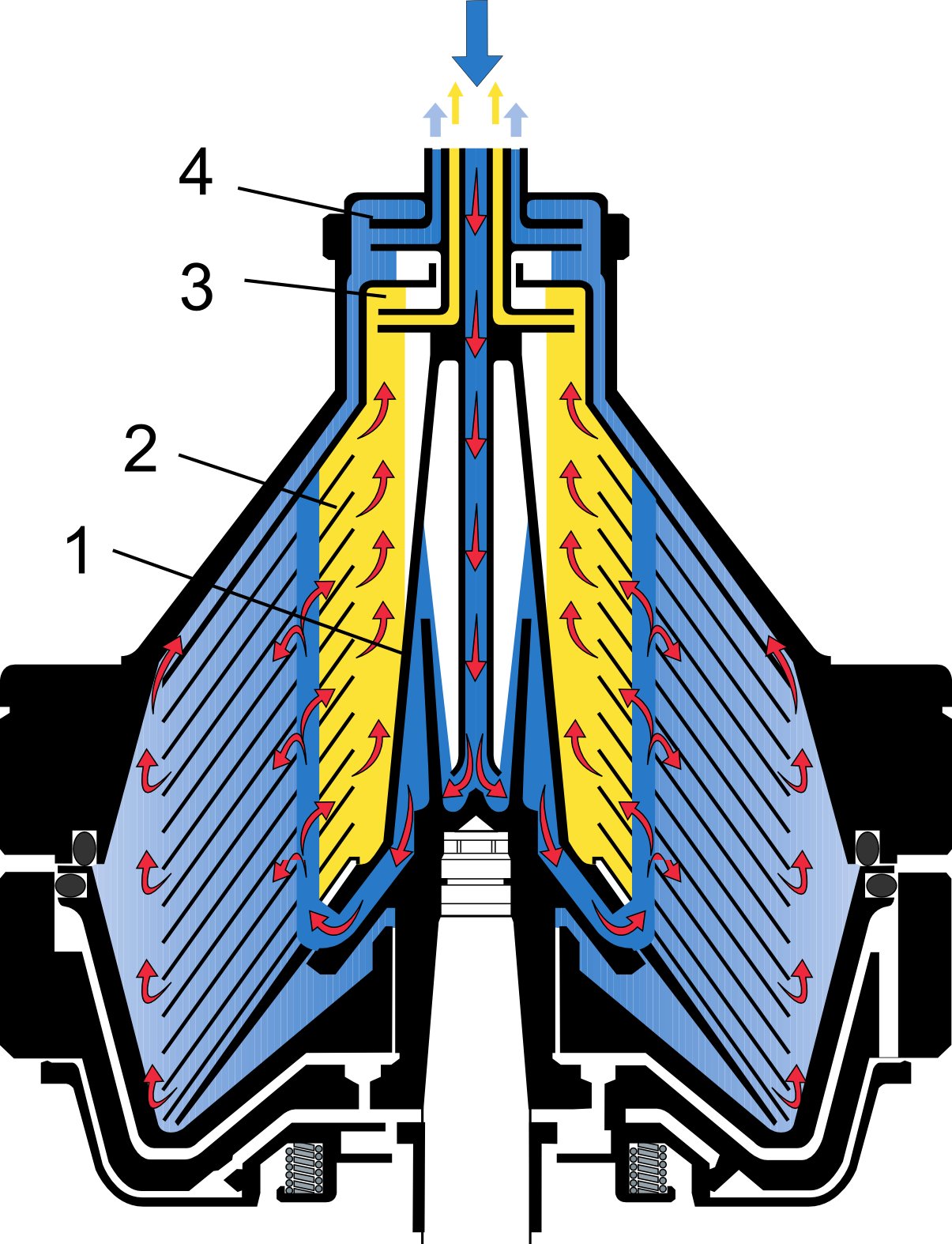
Three bowl configurations
- Clarifier: removes solids from one liquid; the clear liquid leaves under pressure through a paring disc.
- Purifier: separates two liquids of different density and removes the solids, for example water and solids from an oil.
- Concentrator or skimmer: concentrates the light phase, for example cream from milk.
Self-cleaning bowls collect the solids in a sludge space at the bowl wall and discharge them at intervals, either partially or totally, while the machine runs. All functions are executed by a PLC, and operating parameters and alarms are shown on the operator panel.
Applications of disc stack centrifuges
Overall, disk stack centrifuges are valued for their ability to handle high-throughput processes and achieve high levels of separation efficiency.
Disc stack or decanter?
The two machines complement each other. A decanter centrifuge handles feeds with a high solids content and produces a dewatered cake. A disc stack centrifuge spins much faster and is the better choice for low-solids feeds, typically a few percent by volume, where fine particles must be removed or two liquids split cleanly. Many processes, such as olive oil and rendering, use a decanter first and a disc stack separator to polish the liquid.
HAUS self-cleaning separators
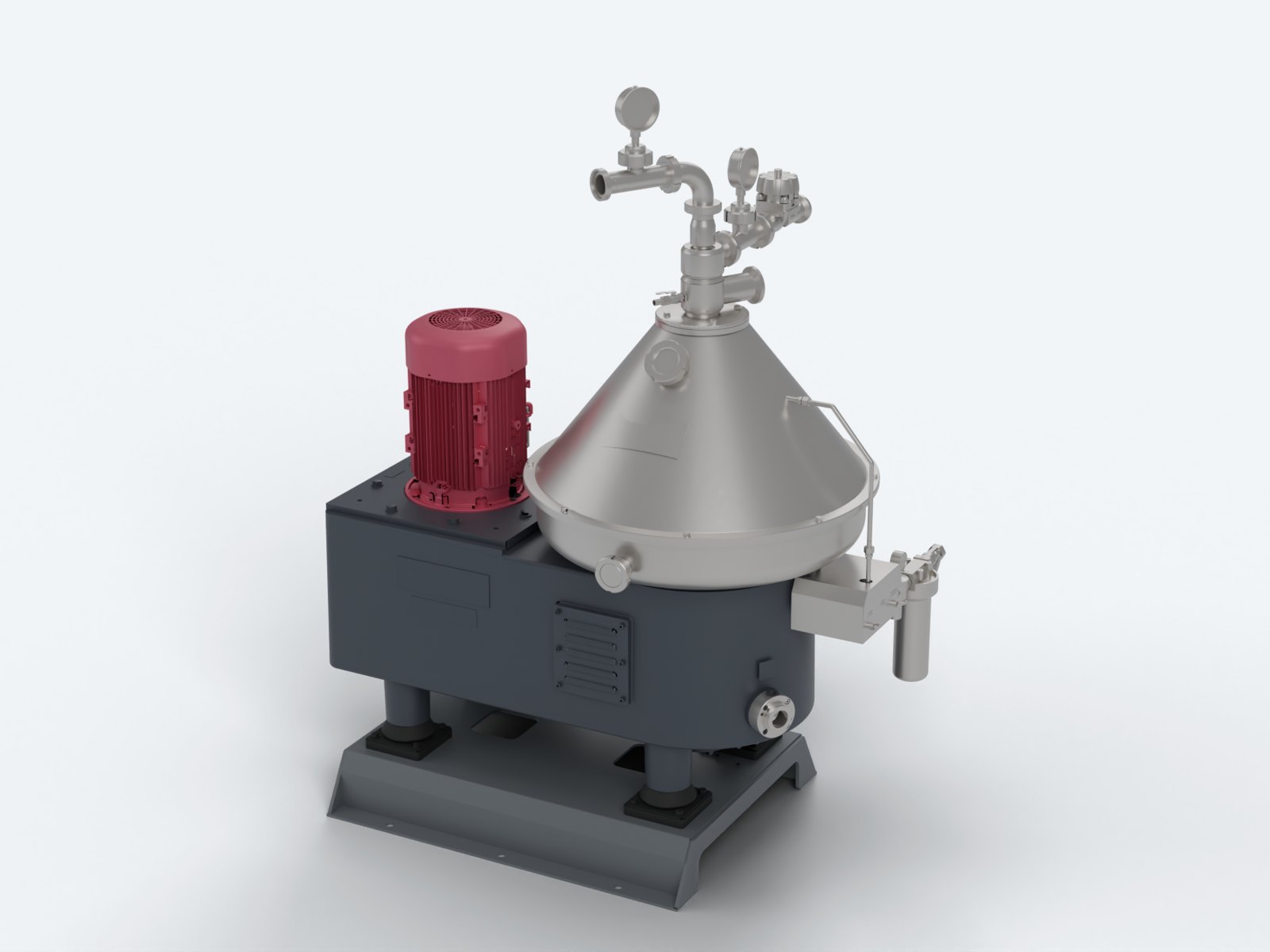

Walk-around of a HAUS IBA disc stack separator: the vertical motor beside the bowl hood, the inlet and outlet head on top.
Juice, wine and beer clarification
Disk stack clarifiers are also widely used in beverage processing. Raw juice, must, young wine or green beer is fed gently from a blanketed tank to a self-cleaning clarifier, which removes yeast, pulp and haze-forming particles and discharges them at intervals without stopping. An inline turbidity reading confirms the clarity of the product. The separator solids and the tank bottoms collect in a lees tank, and a small decanter recovers the liquid from them so less product is lost. Archer can supply the clarifier, the lees decanter and the controls as one hygienic package.
Generic flowsheet for illustration. Every Archer system is designed to its own basis; ask us for one drawn for your plant.
Related pages
Dairy Processing Centrifuges
Milk skimming, clarification and whey separation.
Olive Oil Extraction
Decanters and separators for olive oil.
Plant-Based Milk Alternatives
Preparation and separation of plant-based milks.
Rendering Centrifuges
Fat and protein recovery for beef, poultry and swine.
Decanter Centrifuges
Continuous separation for high-solids feeds.
HAUS Centrifuge Technologies
Our partner for decanters and separators.
Oil Sludge Recovery
Three-phase decanters for slop oil and tank bottoms.
Fish Meal and Fish Oil
Press liquor, fish oil and stickwater separation.
Ethanol Stillage
Wet cake, thin stillage and corn oil.