
Archer Mobile Dewatering Case Study
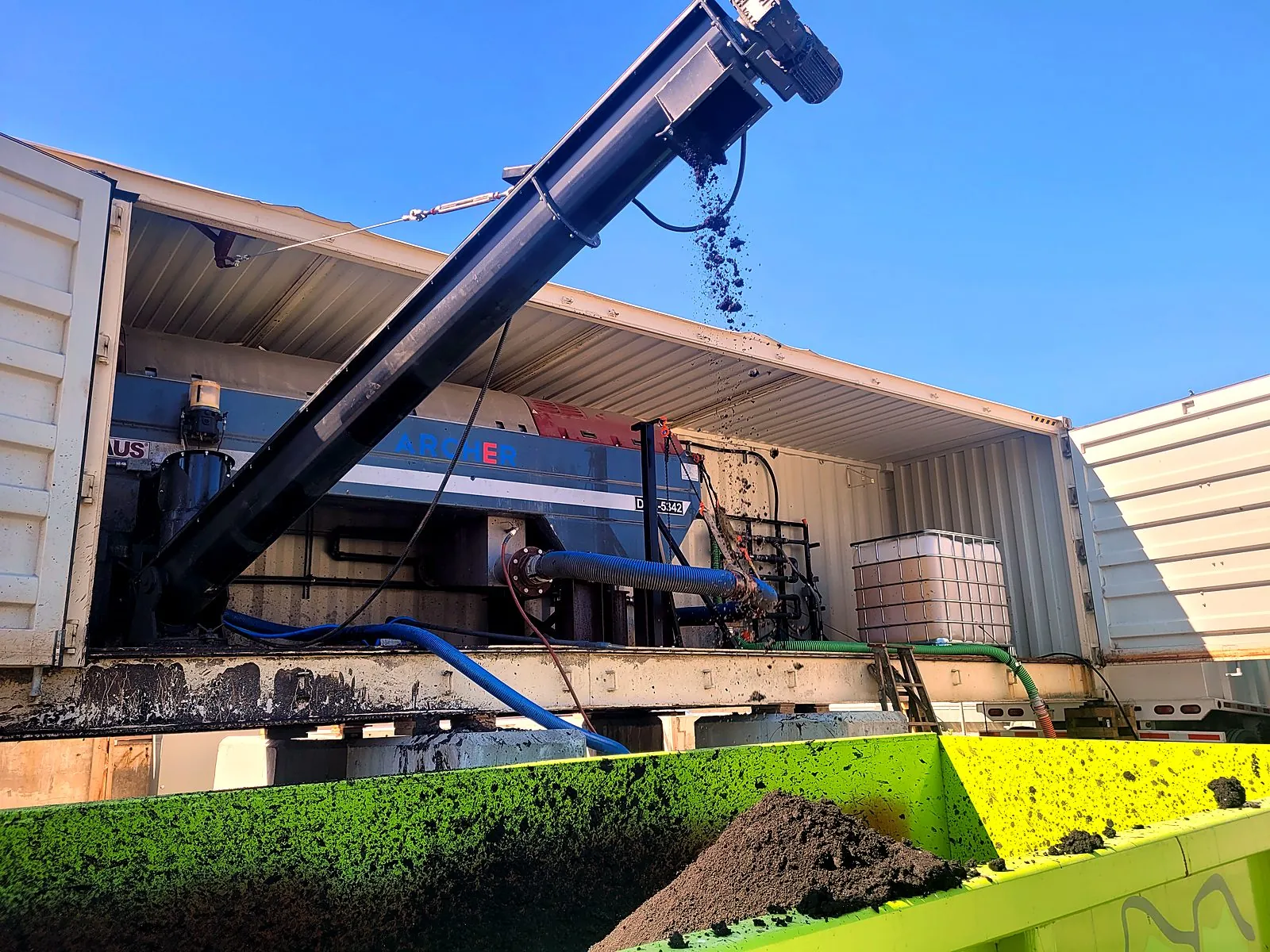
A 40 ft mobile dewatering unit for pilot testing and rental, ready to connect on site.
The application
In 2017 Archer Separation designed its first mobile sludge dewatering unit for pilot testing and rental, so plants can prove dewatering on their own sludge or cover a shutdown.
It is a complete dewatering plant in one container. It arrives by truck, connects to sludge, water and power, and discharges cake into a bin or truck.
In 2019 it was contracted to a municipal wastewater utility in the Alberta Rockies to cover dewatering while the plant’s dewatering system was upgraded. From July to October 2023 a municipal wastewater treatment plant in BC’s Fraser Valley used it to bring down a high sludge inventory in its secondary clarifiers, and ran it again in spring 2024. In mid-2024 it went to a metals recycling facility in Ohio for a two-month rental.
The challenge
A rental unit has to be ready to run on arrival. Power, water and sludge are connected on the day the Archer representative is on site, and plant staff must be able to run the centrifuge after short training. Between rentals the unit is closed up and stored.
What Archer supplied
- 40 ft high cube, open-side container, easy to transport to and from site, with bi-fold doors along one full side, cargo doors at one end and a checker-plate floor
- HAUS DDE 5342 decanter centrifuge, up to 45 m³/h, with a 55 kW main drive and 18.5 kW back-drive on VFDs
- Inclined screw conveyor that swivels in so the unit closes completely for storage, fed by a short screw conveyor under the centrifuge
- Sludge feed pump on a VFD, with a magnetic flow meter on the feed line
- Liquid polymer dosing system for emulsion polymer from a tote, with inline dilution, a static mixer and three injection points
- Allen-Bradley CompactLogix PLC control panel with a touch-screen operator panel
- Completely pre-piped
How it works
The feed pump draws sludge from the plant through a 4-inch cam-lock connection and past the flow meter. A progressing cavity metering pump takes neat emulsion polymer from the tote; it is diluted with service water, mixed through the static mixer and injected into the feed line ahead of the centrifuge.
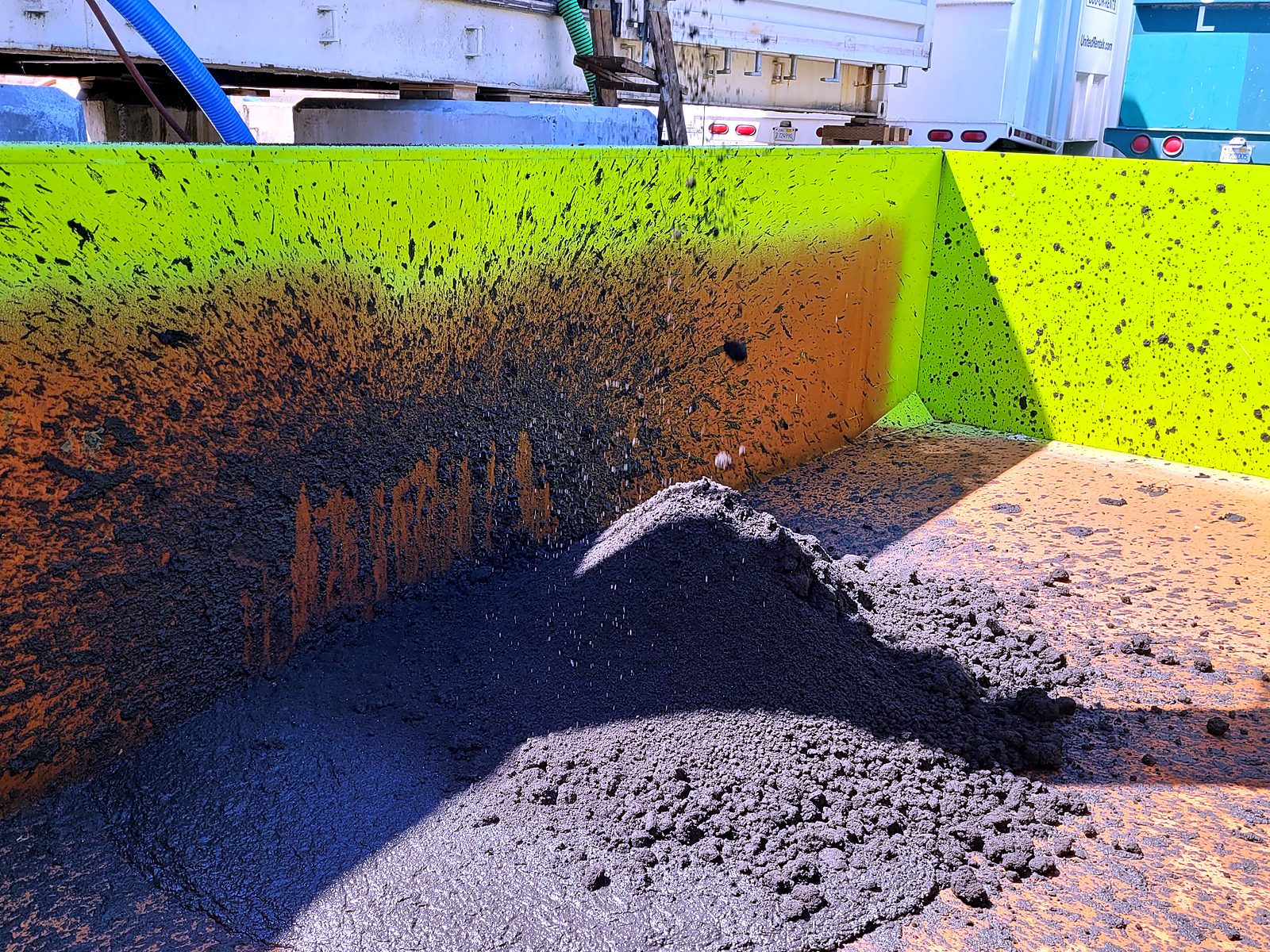
Cake drops from the centrifuge onto the short screw conveyor, and the inclined conveyor lifts it out through the open side into a bin or truck. To give the conveyor enough discharge height, the container is normally set on concrete blocks or left on a flatbed trailer. Centrate leaves through an 8-inch flanged outlet.
The PLC controls bowl speed, differential speed, feed and polymer rates and flushing, and monitors scroll torque, vibration and bearing temperatures.
Before a rental Archer can test a sludge sample in the laboratory to select the polymer. On site Archer supervises set-up, provides start-up and commissioning (typically three days) and trains the operators.
Site connections
| Sludge | 4-inch male cam-lock feed connection |
|---|---|
| Water | 1-1/2-inch forestry coupling; 4 – 5 m³/h at 250 kPa |
| Centrate | 8-inch flanged discharge connection |
| Cake | Screw conveyor discharge to bin or truck |
| Power | 480 V, 3-phase, 60 Hz supply; 150 kVA connected load; 6-inch conduit entry for the power cable |
Equipment
| Container | 40 ft high cube, open side; 12.2 × 2.4 × 2.9 m |
|---|---|
| Weight | About 15,000 kg (33,000 lb) |
| Centrifuge | HAUS DDE 5342, dual drive, 536 mm bowl inside diameter |
| Capacity | 40 – 45 m³/h |
| Main drive / back-drive | 55 kW / 18.5 kW, VFD |
| Feed pump | 3-inch self-priming pump, 7.5 kW, VFD |
| Polymer system | Progressing cavity metering pump, inline dilution, static mixer |
| Cake conveyors | Short screw under the centrifuge and inclined swivelling screw, 2.2 kW geared motors |
Related: Containerized Centrifuge Systems · Sludge Dewatering · All case studies