
Control Panels
Archer designs and builds the control panels that run our centrifuges, DAF, polymer and chemical systems.
Archer Separation builds and provides control panels for a wide range of equipment and systems. A control panel is the interface used to manage, monitor and control machines and devices: it gives operators the settings, options and configurations they need to run and troubleshoot equipment efficiently. Control panels are used across many industries, including technology and manufacturing, and they are a critical part of our separation and dewatering systems.

Every Archer panel starts from the process. Our engineers write the control philosophy, draw the schematics in-house and program the PLC and the operator screens, and the panel is built in British Columbia by a CSA and UL certified panel shop. The result is a panel that runs the machine the way it was designed to run, protects it when something goes wrong, and shows the operator what is happening.
What our panels control
What goes into an Archer control panel
Control and operator interface
- PLC or industrial embedded PC; our standard centrifuge panel uses a Beckhoff controller programmed in TwinCAT 3
- Or the PLC platform your plant has standardized on
- Touchscreen HMI on the door, from 7-inch to 15-inch multi-touch, with trends and alarms
- Spare I/O for future additions
Drives and motor control
- Variable frequency drives for the centrifuge bowl and back drive, feed and polymer pumps, screw feeders and conveyors
- Drives networked to the controller over EtherNet/IP or Modbus
- Motor circuit breakers, contactors and line reactors sized for each motor
- Emergency stop through safety relays, with Safe Torque Off on the main drives
Instruments and signals
- I/O list taken from the system P&ID
- Flow, level, pH, pressure and turbidity transmitters
- Vibration and bearing temperature on centrifuges
- One terminal per PLC signal for clear wiring and fault-finding
Connectivity
- Managed industrial Ethernet switch for the controller, drives and HMI
- Secure VPN for remote support
- Links to plant SCADA, including remote start and status signals
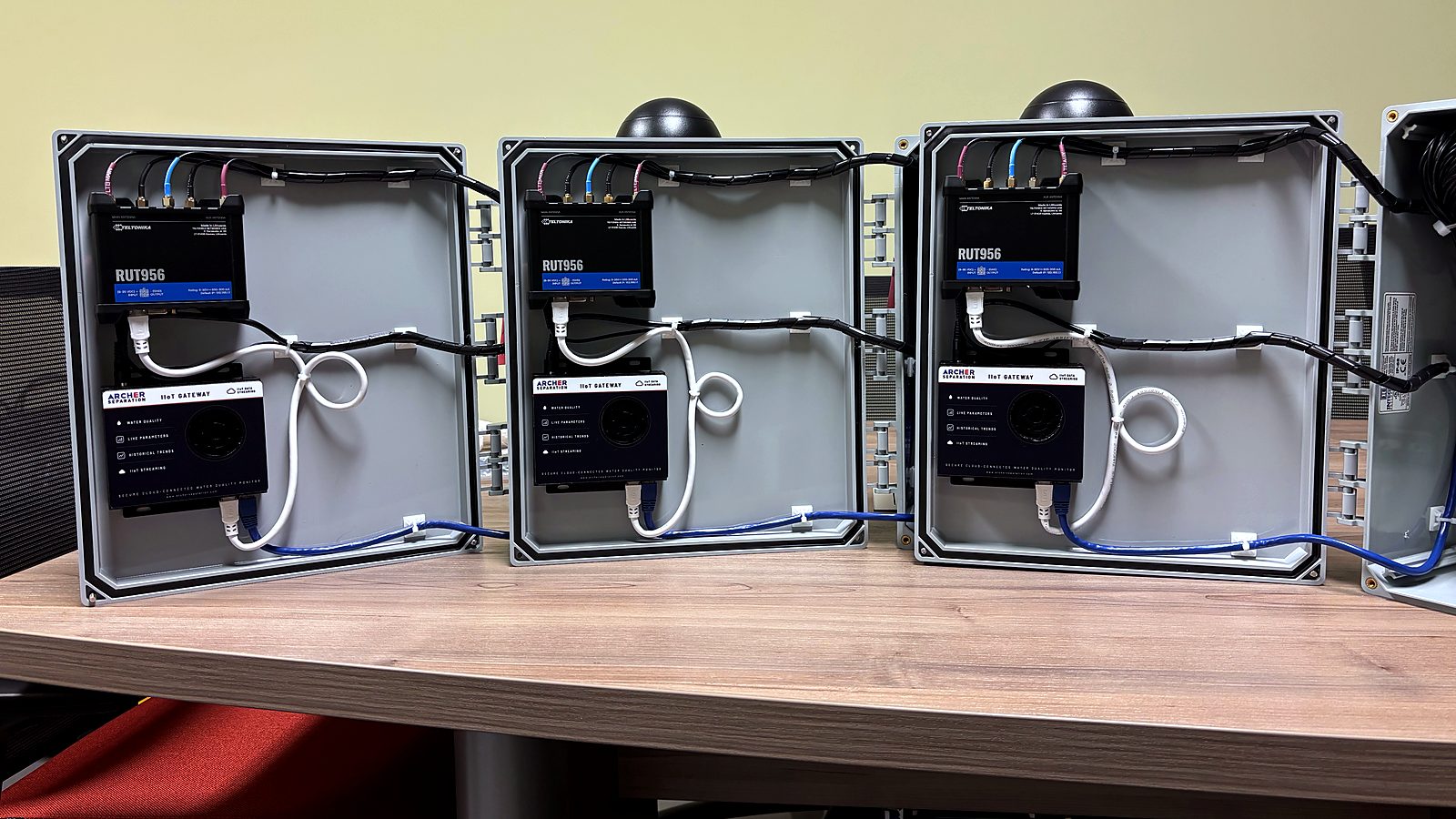
- Ready for the Archer IIoT Gateway and remote monitoring
Centrifuge control panels
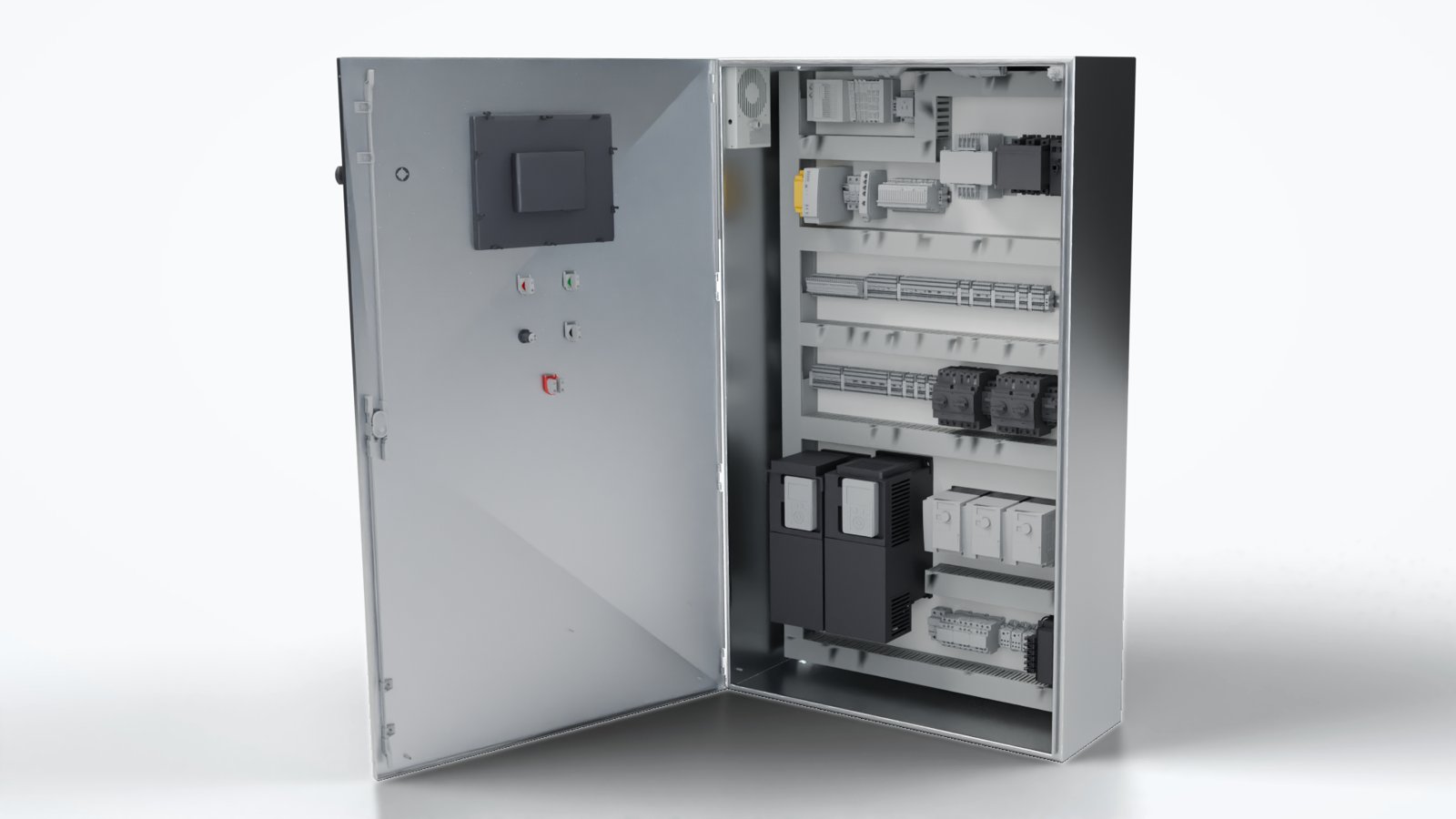
A decanter centrifuge needs two drives working together and a controller that watches the machine every second. Our centrifuge panels run the complete dewatering unit: centrifuge, sludge feed pump, polymer system and cake conveyor.
- Main and back drive: one VFD turns the bowl, a second sets the scroll speed; the drives can share a common DC bus so the braking energy of the back drive is reused
- Differential speed and torque control: run on constant scroll torque or on a fixed differential speed
- Machine protection: bearing temperatures and vibration are monitored continuously, with a warning level that stops the feed and a trip level that shuts the machine down
- Feed and polymer: sludge feed pump, polymer feed and dosing pumps and the make-down mixer on VFDs or starters, with tank level interlocks
Torque limits
If scroll torque rises past its first limit, the feed stops automatically. If it keeps rising, the panel takes the machine through a controlled stop and flush instead of letting it plug.
Safe start and stop
Flush valves open on start-up, on shutdown and after an abnormal stop. A restart is blocked until the bowl has run down, and the emergency stop removes torque from both main drives.
Plant integration
Remote start and stop, a ready signal, alarms and running values go to the plant over Modbus or hard-wired I/O; conveyors, diverter gates and autogreasers are interlocked with the centrifuge.
Example from a recent unit: feed stop at 80 °C bearing temperature, 12 mm/s vibration or 80 % scroll torque; shutdown at 90 °C, 16 mm/s or 90 %. Set points are agreed for each machine.

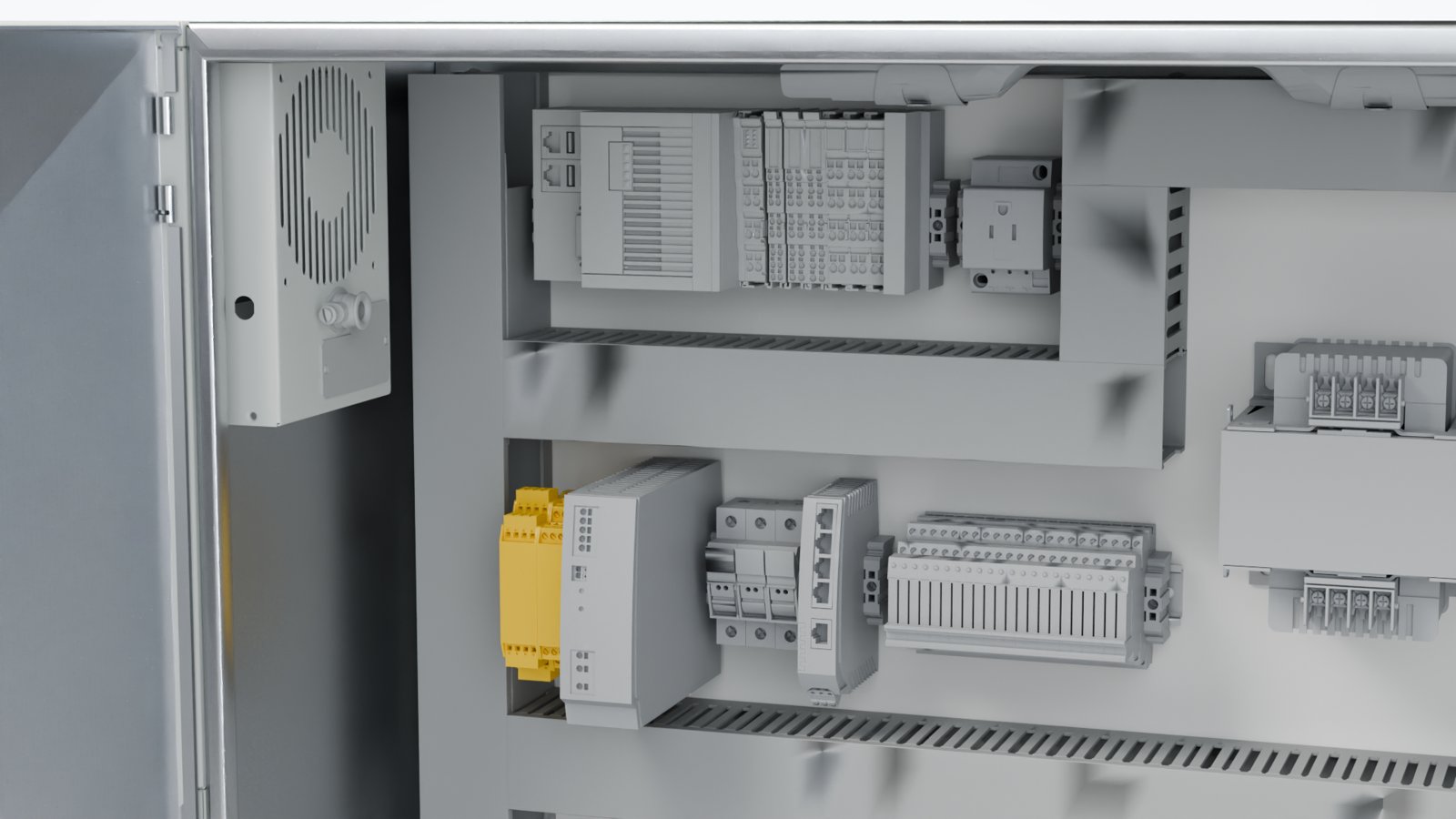
Controller and I/O
An embedded PC with EtherCAT I/O for digital, analog, encoder and Modbus signals. A remote I/O box on the centrifuge reads bowl speed, vibration and bearing RTDs close to the machine.
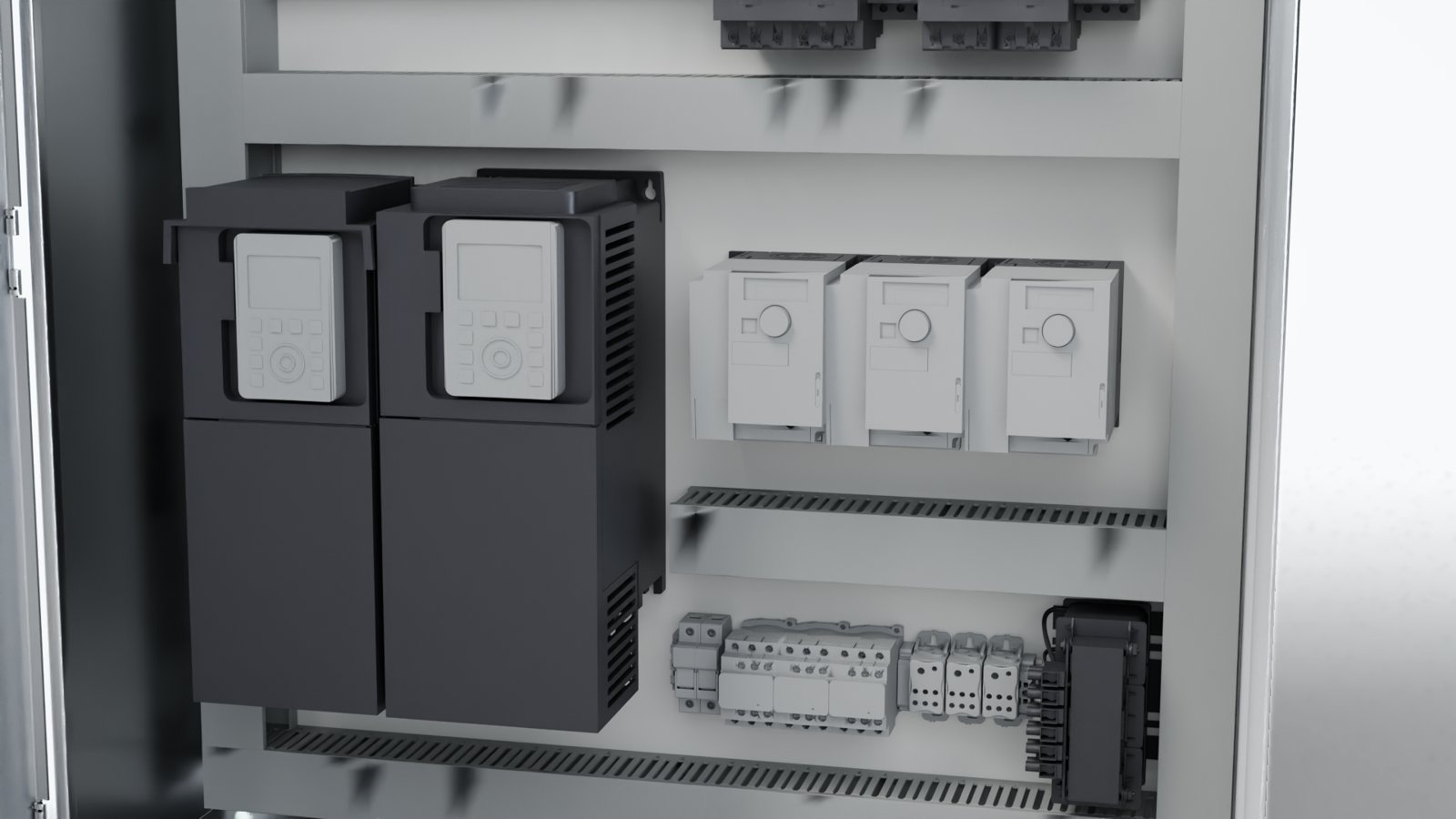
Drive section
Main and back-drive VFDs on the left, smaller drives for the sludge feed and polymer pumps beside them, and a line reactor, contactors and power distribution along the bottom.
Panels for hazardous areas
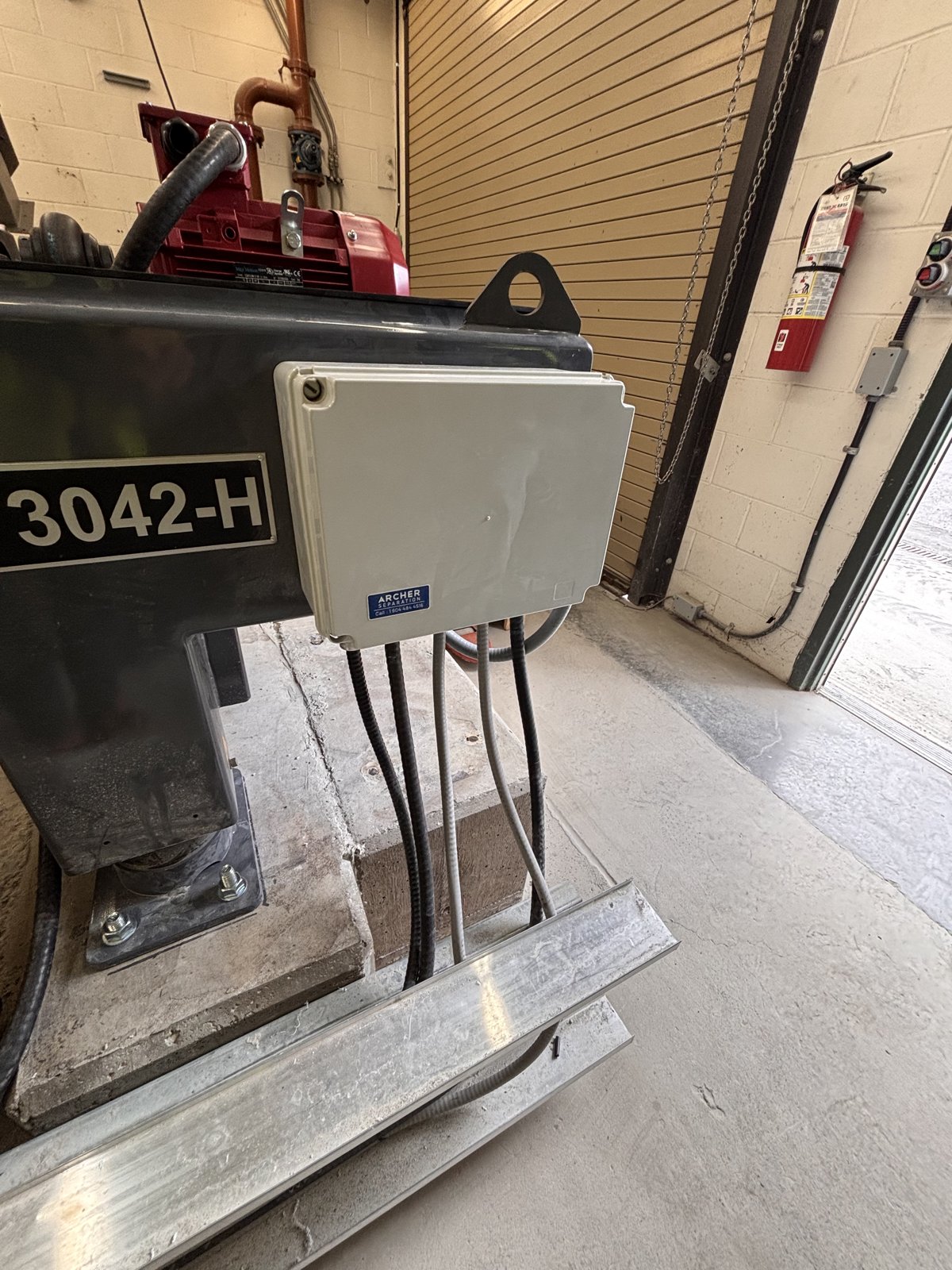
Dewatering rooms are often classified hazardous locations. At a municipal wastewater plant in BC, the room around the decanter is Class I, Division 2, so we split the system: the control panel with the PLC and drives stands in the general-purpose area, and everything inside the classified room is rated for it.
- Class I, Division 2 motors on the centrifuge main and back drives, the feed pump and the cake conveyor, with a dV/dt filter on every drive output
- A 15-inch multi-touch operator panel rated for Zone 2 at the machine, linked to the PLC over a single cable
- Intrinsically safe circuits for bearing temperatures and field sensors, through zener barriers and Ex i I/O terminals; the panel is cUL certified, including intrinsic safety
- Low-power, intrinsically safe flush valves
Read the wastewater plant case study.
DAF control panels
Dissolved air flotation depends on getting the chemistry right. Our DAF panels run the chemical side of the process: polymer make-down and dosing, coagulant and pH control, with the process instruments that show whether the dose is working.
- Polymer make-down: dry polymer screw feeder, hopper loader, wetting water flow and solenoid, maturation tank mixers and tank levels
- Dosing pumps: polymer dosing pumps on VFDs, with pump speed set from the PLC
- Chemical dosing and pH: coagulant, acid and caustic metering pumps with PID pH control
- Dose on demand: dosing paced on flow and trimmed on effluent TSS
- Alarms and interlocks: high-high tank level and low hopper level alarms stop the right equipment

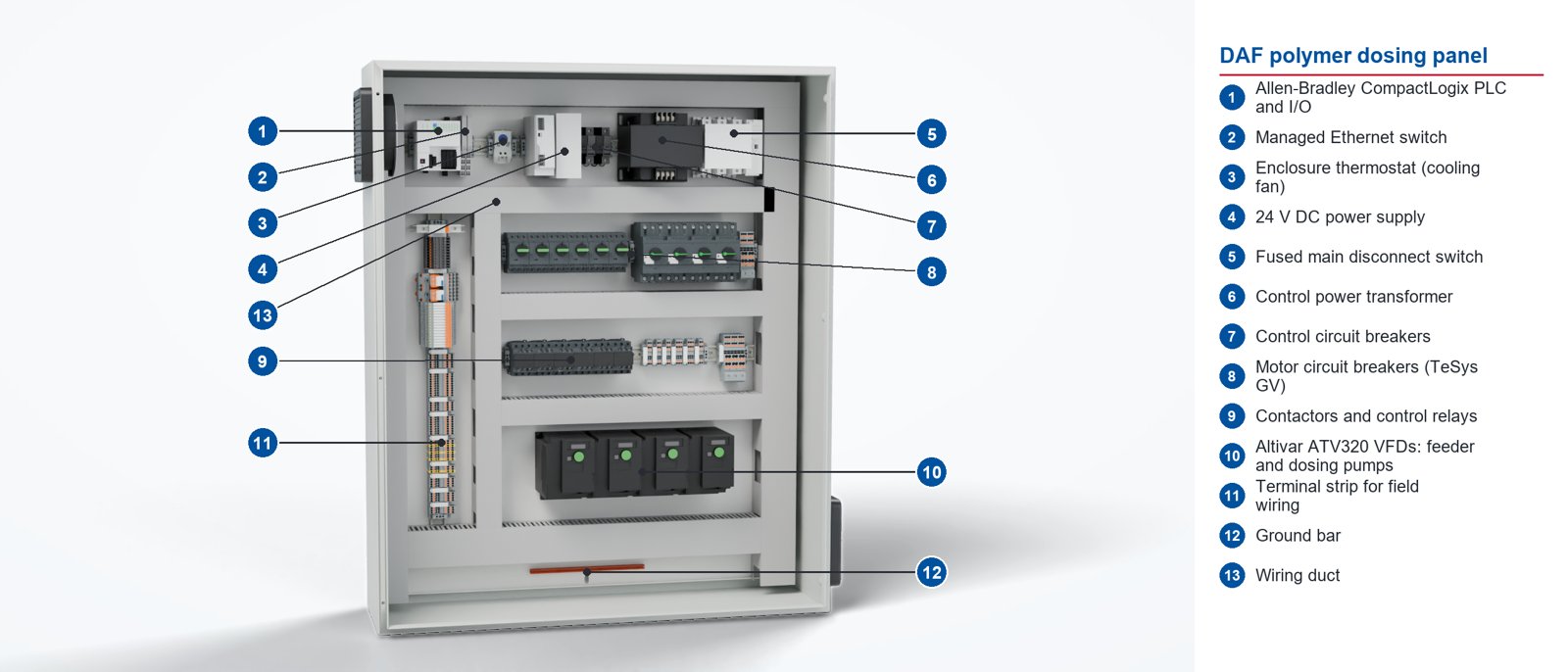
The same panel design runs polymer systems for dewatering. See our polymer systems and chemical systems for the equipment these panels control.
IIoT and remote monitoring panels

The Archer IIoT Gateway adds monitoring to new and existing equipment. As a DAF process controller it runs up to four metering pumps and three self-tuning PID loops from a 7-inch touchscreen; as a monitoring unit it reads centrifuges and plant PLCs of any make.
- Connects over Modbus RTU and TCP, EtherNet/IP and 4–20 mA
- Logs on the unit and streams to the cloud over MQTT with TLS encryption
- Read-only monitoring: the control logic in your PLC is never changed
- Trends, alarms and reports for operators and for our engineers
More on the Remote Monitoring page.
Supported from our office
Archer panels can be set up for secure remote access by our engineers, so we can check alarms, review trends and adjust settings without a site visit, and with our remote monitoring service we watch your equipment and step in before a small problem stops production.
PLC platforms we work with
We build on the platform that suits the project, and on your plant standard when you have one, so your maintenance team works with hardware and software it already knows.
Beckhoff
Our standard for centrifuge panels: CX embedded PCs programmed in TwinCAT 3, EtherCAT I/O, remote I/O couplers at the machine and CP multi-touch panels.
Allen-Bradley / Rockwell
CompactLogix controllers with Compact and POINT I/O, PanelView operator panels and EtherNet/IP drives, for plants that run on Rockwell.
Schneider Electric / Modicon
Modicon PLCs with Harmony operator panels. Altivar drives are our standard VFDs, on EtherNet/IP or Modbus, whichever PLC runs the panel.
Siemens
SIMATIC S7-1200 and S7-1500 with ET 200SP I/O, and SINAMICS drives, where Siemens is the plant standard.
Designed and built to code
| Canada | Industrial control panels to CSA C22.2 No. 286, installed under the Canadian Electrical Code (CSA C22.1) |
|---|---|
| United States | UL 508A industrial control panels and the NEC |
| Enclosures | Typically NEMA 12 painted steel for indoor process areas; Type 4X for washdown, outdoor and containerized installations |
| Rating nameplate | Supply voltage, full-load data and short-circuit current rating (SCCR) on every panel |
| Cable entries | Top, bottom or sides only, never through the back of the panel |
| Supply | To suit the site, for example 600 V or 480 V, 3-phase, 60 Hz, with 120 V AC and 24 V DC controls from a control transformer and DC power supply |
| Cooling | Thermostat-controlled fans, or a panel air conditioner where the room runs hot |
| Safety | Emergency stop through safety relays, Safe Torque Off on the main drives, finger-safe components |
| Documentation | Schematics, panel layout, bill of materials, I/O list and control narrative, updated to as-built |
How we deliver a panel
Define
We agree the control philosophy and build the I/O list from the P&ID.
Design
Schematics, panel layout and bill of materials drawn in-house in EPLAN and reviewed before anything is bought.
Build and test
The panel shop builds and wires the panel, then inspects and tests it before it ships: point-to-point wiring and I/O checks, a power-on test and a check of the operating logic. Factory acceptance testing is available on request.
Commission
On-site start-up with your equipment, operator training and ongoing remote support.
Related pages
Remote Monitoring
IIoT Gateway and centrifuge monitoring service.
Decanter Centrifuges
Continuous dewatering and separation.
DAF Systems
Dissolved air flotation for industrial wastewater.
Polymer Systems
Polymer make-down and dosing.
Skid Systems
Equipment, piping and controls on one skid.
Containerized Systems
Complete dewatering plants in a container.