
Meat Processing and Water Clarification
Dissolved-Air Flotation Systems Optimize your Meat Processing Systems and Prevent Wastewater Pollutants!
Meat processing wastewater is one of the most demanding separation tasks there is, with some of the highest biodegradable loads of any industry. Blood, bone, fat and tissue give the solids widely varying densities, and the water and chemicals used to clean and sterilize the plant can become pollutants in their own right.
Generic flowsheet for illustration. Every Archer system is designed to its own basis; ask us for one drawn for your plant.
Can meat processing wastewater be treated with less added chemistry, while recovering water for reuse in the plant? Yes. Archer Separation partners with industry-leading manufacturers of separation and dewatering equipment that dramatically improve results on slaughterhouse and meat processing wastewater, with removal efficiency up to 99%.
How a DAF system clarifies meat processing wastewater
The equipment that does this is Dissolved Air Flotation, or “DAF”. A DAF system first conditions the wastewater chemically so the solids clump together, then floats them to the surface with fine air bubbles and skims them off.
Our partner SIGMA DAF Clarifiers shows the process in this diagram.

Separating the large volume of organic solids from meat processing wastewater takes four stages: pre-screening, coagulation, flocculation and finally dissolved air flotation itself. Archer Separation provides the equipment, remote monitoring and services to optimize each stage for the best clarification.
Pre-screening
A series of progressively finer screens takes the wastewater down to a consistent particle size. Because by-products differ from plant to plant, SIGMA DAF Clarifiers recommends sieves, screens and bypasses case by case; Archer Separation has a proven record for this kind of customization.
Coagulation
A versatile, low-toxicity coagulant such as polyaluminium chloride (PAC), matched to the pH of your wastewater, is mixed in rapidly so the fine solids and fats destabilize and start to clump. With the right chemistry, pH and mixing, this takes only about five minutes. We set this up for you on site and remotely.
Flocculation
Polymer is added and the water is stirred gently by special mixers that grow the clumps into large, strong flocs without breaking them up. The equipment is robust, and this slower stage takes only about ten minutes.
Dissolved air flotation
After about fifteen minutes of conditioning, the water enters the DAF basin, where micro-bubbles attach to the flocs and lift them to the surface. A scraper removes the floating solids continuously, leaving clear water and a float that is already thickened.
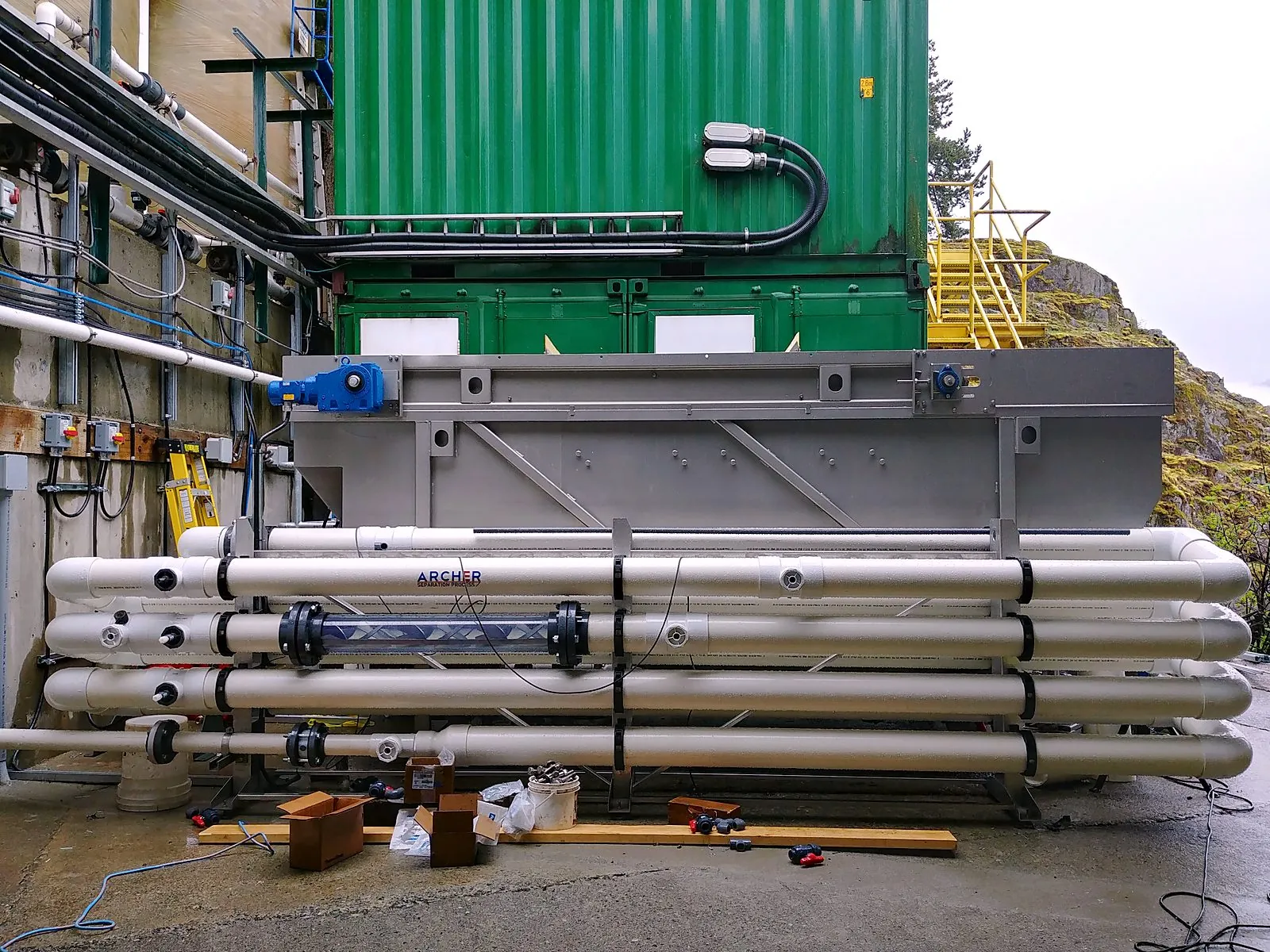
What an Archer DAF system includes
- Stainless steel DAF unit with lamella plates, chain-driven float scraper and ventilated covers
- Recycle pump that makes the micro-bubbles directly, with no separate saturation vessel or compressor
- Pipe flocculator with a static mixer and injection points for coagulant, pH correction and polymer
- Polymer make-down and chemical dosing skids
- Effluent TSS and pH sensors, flowmeters and automatic dose control
After the DAF: water reuse and solids
Reclaimed water
The clarified water can be recycled as washwater in your plant. It is easier to sterilize and saves you on water costs and pollutant fees.
Drier solids
Compared with non-DAF alternatives, the sludge carries more solids. After further concentration, digestion or sterilization it is typically ready for responsible disposal, and the float can be dewatered further in a decanter centrifuge.
Primary treatment or polishing
There are many details specific to your plant that a DAF system can help with, whether as your primary wastewater clarification step or as a cost-effective supplement to a biological treatment process. Archer Separation is committed to helping you integrate solutions that meet your needs for hygiene, efficiency and cost-effectiveness.
Choose the chemistry on evidence
Our JarLab platform keeps every jar test and lab analysis in one record, finds the programmes that worked on similar waters and issues permit-checked treatment reports.
Related pages
DAF / Dissolved Air Flotation Systems
Archer DAF systems for industrial wastewater.
Sigma DAF Clarifiers
The DAF clarifiers we supply with SIGMA.
Rendering Centrifuges
Recover fat, water and protein from beef, poultry and swine by-products.
Polymer Systems
Make-down and dosing for flocculation.
Food Processing
Separation and dewatering across the food industry.
Remote Monitoring
Dose control and process data from anywhere.
We understand your meat processing, meat wastewater clarification, and other dissolved-air flotation requirements, and will meet those needs with the best technology available!
Contact us today with all your separation or dewatering challenges. Call 604.484.4516 or reach us through our online form.