
Alberta Rockies Municipal WWTP: Duty/Standby Centrifuges Case Study
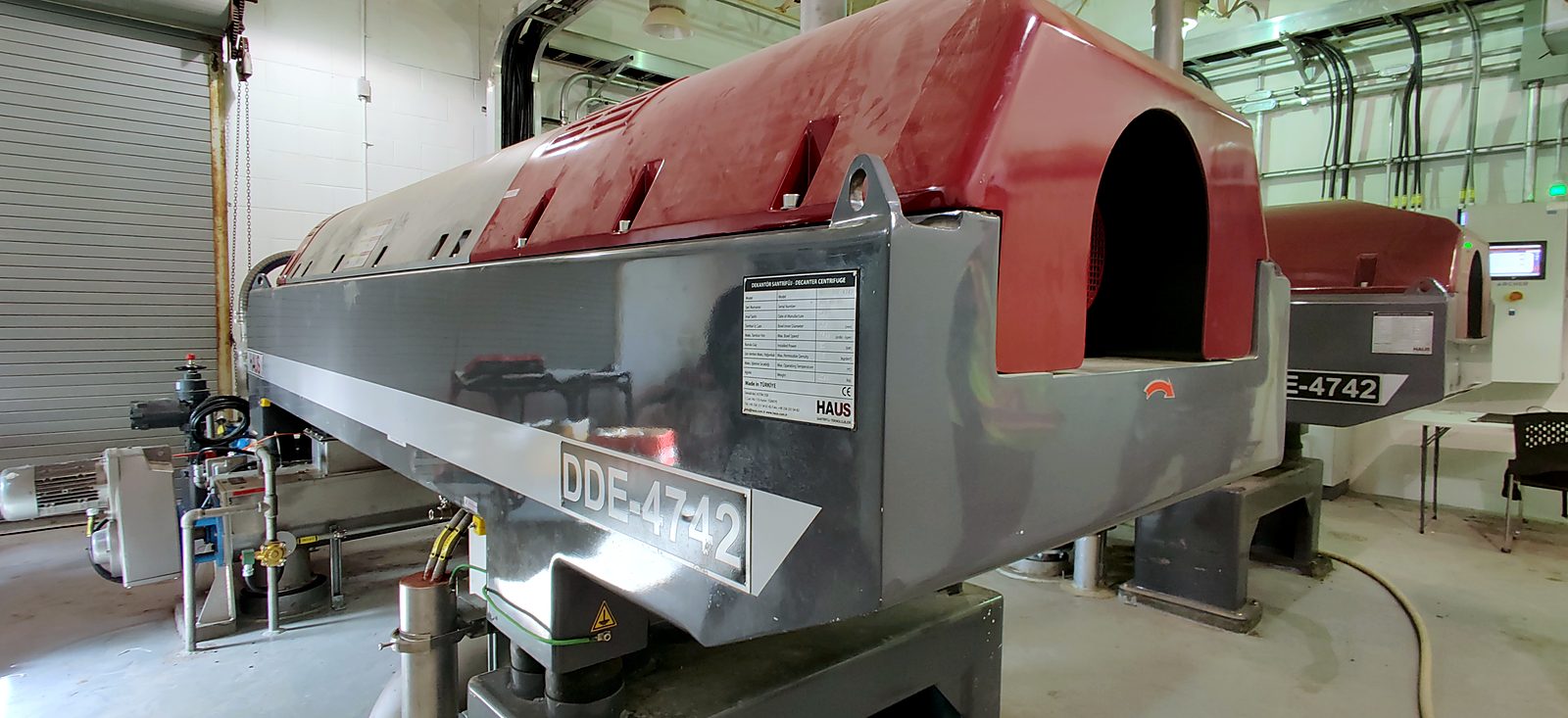
Two HAUS DDE 4742 decanter centrifuges dewater up to 235 m³ of biological sludge per day.
The application
Archer won the bid to supply a dewatering system to a municipal wastewater treatment plant in the Alberta Rockies, which produces up to 235 cubic meters of biological sludge per day.
The design feed is a blend of primary sludge and backwash sludge from the plant’s biological aerated (BAF) treatment stage, thickened by dissolved air flotation: about 1.8 % solids at a 60:40 primary to secondary ratio. The system is sized for the plant’s future flow in one 8-hour shift a day, and the cake is conveyed to a truck for haul-off.
The challenge
The centrifuges replaced the plant’s belt press. In a trial on the plant’s sludge in May 2017, before the tender, a centrifuge produced about 19 to 21 % cake; a cake sample taken off the belt press at the same time was 12.7 %.
Dewatering could not stop during construction: the operators ran a rental centrifuge from July 2017 until the new system started. Winter air reaches −30 to −35 °C, so any connection open to outside air had to be protected from freezing.
What Archer supplied
- Two HAUS DDE-4742 decanter centrifuges, one duty and one standby, each sized for the full design flow of 29.5 m³/h
- Master control panel with a Schneider Modicon M340 PLC and a 12-inch colour touch screen
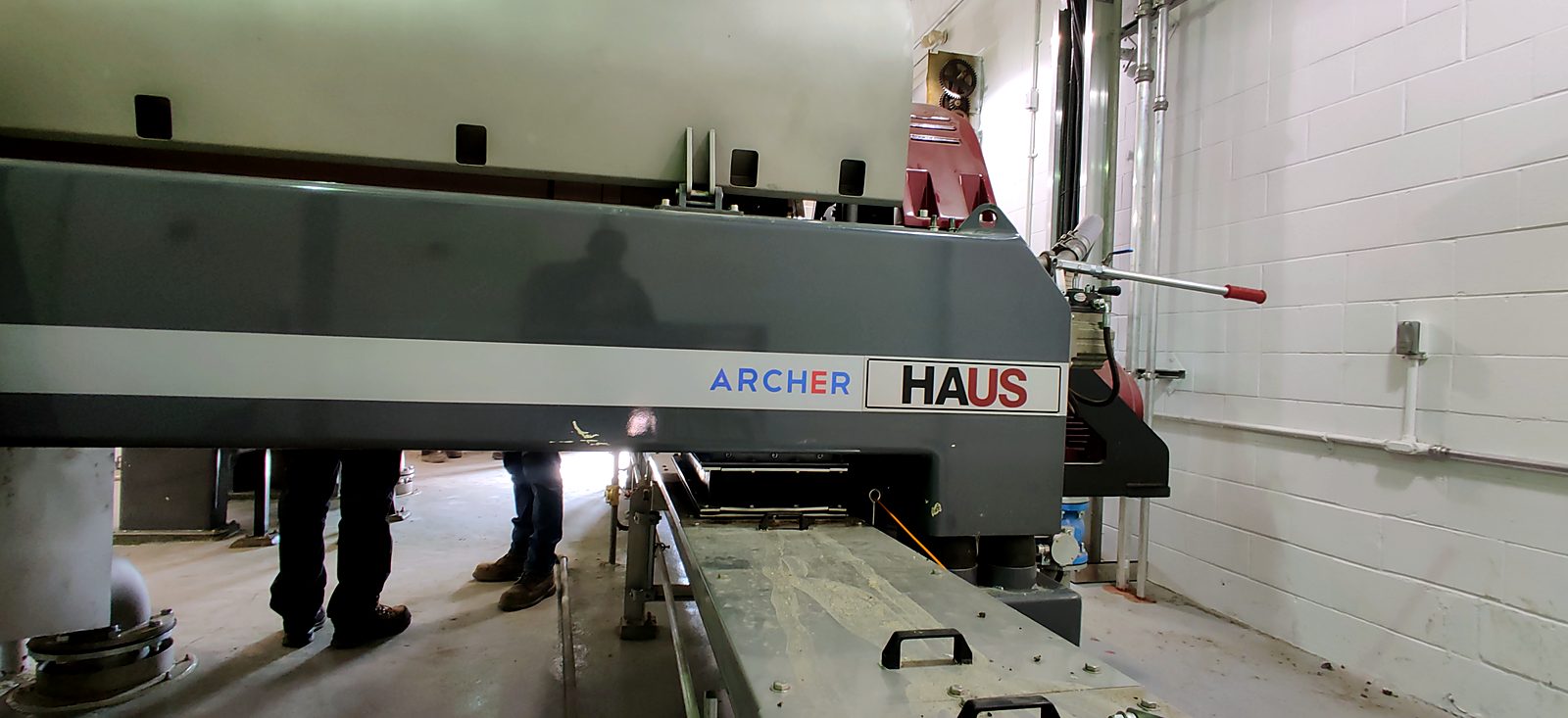
- Epoxy-coated stands that lift each centrifuge about 500 mm above the conveyor, with local disconnects and emergency stops
- Motorized flush valves, vibration transmitters, bearing temperature sensors, special tools and two years of spare parts
- Commissioning and performance testing, and operator training
Engineering
One PLC in the master control panel runs both centrifuges. It talks to the drive panel on each machine over Modbus TCP/Ethernet, so neither centrifuge needs its own PLC. The same panel controls the feed pumps, polymer feed and conveyors, and is the single connection to the plant PLC.
Each centrifuge has two motorized flush valves: one flushes the bowl at start-up, shut-down and on high torque or vibration; the other flushes the sludge diverter gate.
Results
During commissioning in October and November 2019 the centrifuges ran at 22 to 27.5 m³/h on sludge from the digesters at 2.4 to 3.0 % solids, thicker than the 1.8 % design feed. Over the sampled runs:
- Cake solids of 20.5 to 26.6 %, median 21 %, against a guarantee of 21 % ± 1 %
- Solids capture of 98.3 to 99.6 %, against a guarantee of 95 %
- Centrate of 115 to 568 mg/L suspended solids
- Median polymer dose of about 5.7 kg per dry tonne, below the design figure of 9 kg per dry tonne
- Solids throughput of up to about 770 kg of dry solids per hour on one machine
Archer continues to supply service and spare parts for both machines.
Design basis
| Sludge | Biological sludge, up to 235 m³/day |
|---|---|
| Feed solids | 1.8 % (design) |
| Feed rate | 29.5 m³/h per centrifuge |
| Cake | 21 % ± 1 % dry solids (guarantee) |
| Solids capture | 95 % or more |
| Polymer | Less than 9 kg per dry tonne |
The system was commissioned and performance tested successfully. Results are from the commissioning laboratory record.
Equipment
| Centrifuges | 2 × HAUS DDE 4742, dual drive |
|---|---|
| Bowl | 470 mm, duplex stainless steel 2205; up to 3,400 rpm and 3,050 G; L/D 4.05 |
| Scroll | AISI 304 stainless steel, tungsten carbide on flights and feed zone |
| Drives | 37 kW main motor, 11 kW back-drive, variable frequency drives in NEMA 12 enclosures |
| Hydraulic capacity | 40 m³/h per centrifuge |
| Controls | Master control panel, Schneider Modicon M340 PLC, CSA certified |
Related: Municipal Wastewater Treatment · Sludge Dewatering · All case studies