
Mining Tailings Dewatering and Process Water Recovery
Thickening and decanter dewatering that turn fine tailings into a stackable cake and send clear water back to the mill.
Tailings ponds hold water a mine could be using, take years to consolidate and carry long-term risk. Dewatering the fine fraction with a decanter centrifuge turns it into a cake that can be stacked or used as backfill, and recovers the water for reuse in the plant. Archer Separation supplies the decanters, polymer systems and controls, and can pilot the process on your own tailings with a containerized unit.
The challenge: fine solids that will not settle
Coarse tailings drain and consolidate on their own. The fine fraction, clays and slimes, settles slowly and holds a large amount of water for a long time. Thickeners recover part of the water, but the underflow is still a slurry. Fine tailings are also abrasive, so any mechanical dewatering has to be built for wear.
Water
Water locked in the pond has to be replaced with fresh water, which is scarce or permitted at many sites.
Footprint and risk
Wet tailings need large, engineered impoundments that must be monitored for decades.
Abrasion
Silica and other hard minerals wear scrolls, bowls and pumps quickly unless they are protected.
Typical process flow
Generic flowsheet for illustration. Every Archer system is designed to its own basis; ask us for one drawn for your plant.
How the process works
Thicken
Flocculant is added to the tailings slurry and a thickener settles the solids. The overflow returns to the plant as process water.
Condition
The thickener underflow is pumped to the decanter. A density and flow measurement paces the polymer dose.
Dewater
A wear-protected decanter separates the conditioned underflow into a dry cake and a clear centrate.
Stack and reuse
A conveyor places the cake on a dry stack or in backfill, and the centrate joins the overflow for reuse.
Built for abrasive solids
Decanters for tailings need hard-facing on the scroll flights, replaceable wear inserts in the feed zone and solids discharge, and enough torque to move a dense cake. Machine size and wear protection are selected for each application from test results on your material.
Our engineers also select the slurry pumps, polymer system and controls so the whole train is sized for the same duty.
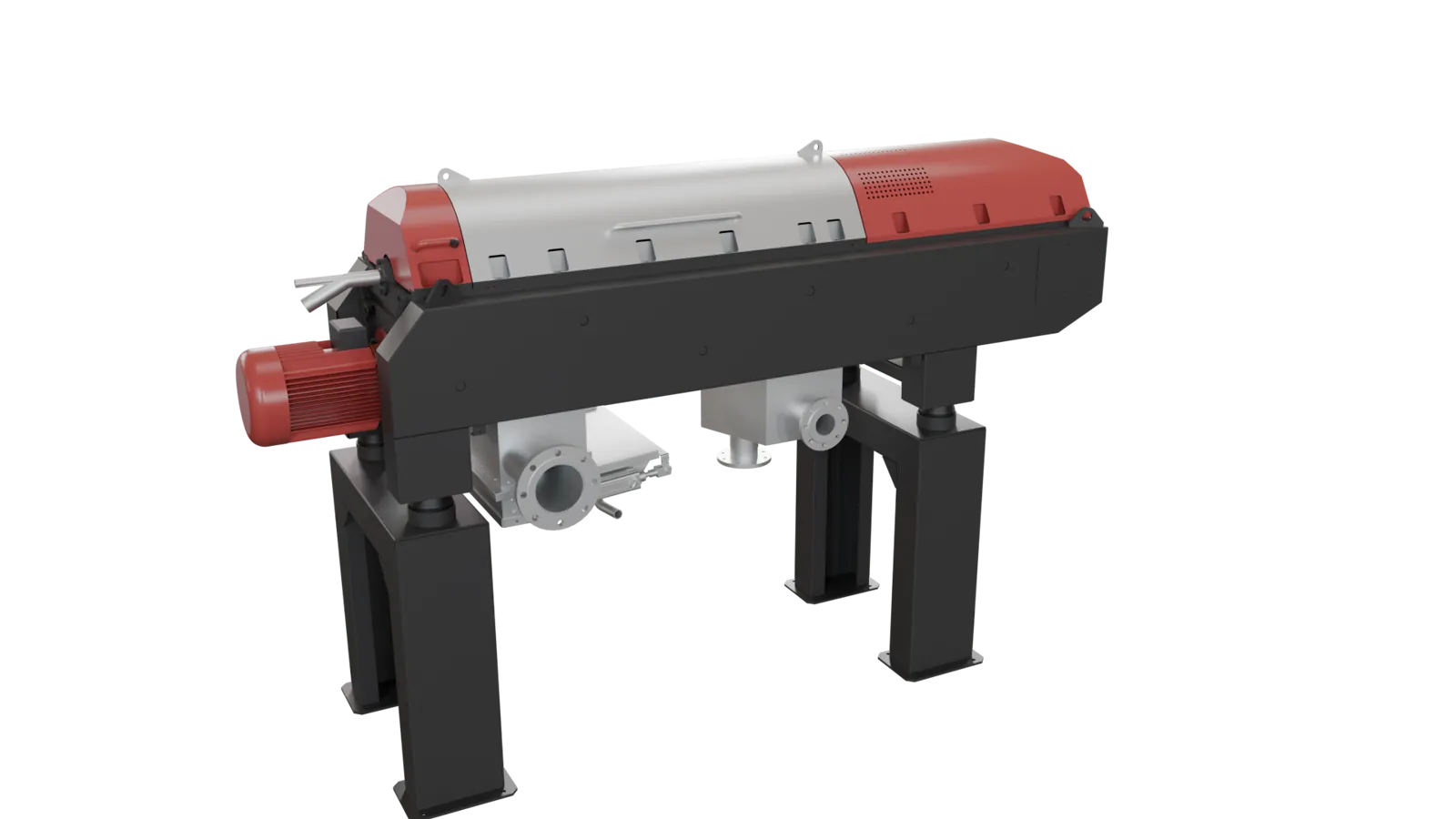
What Archer supplies
HAUS decanters
High-torque decanters from our partner HAUS Centrifuge Technologies, with wear protection selected for the solids you process.
Polymer and chemical systems
Polymer make-down and dosing, paced on solids load, and chemical dosing skids for coagulants and pH.
Clarification
Lamella separators and DAF systems where process water needs further clarification.
Packaged systems
Containerized and skid-mounted trains with control panels and IIoT remote monitoring for remote sites.
Typical design basis
The figures below are typical. Mineralogy, particle size and clay content change them a great deal, so we always test before we size a system.
| Feed | Thickener underflow, typically 20–35 % solids by weight |
|---|---|
| Conditioning | Polymer paced on density and flow |
| Cake | Typically 55–65 % solids by weight for fine tailings; stackable |
| Water | Thickener overflow and centrate recovered for reuse |
| Machine selection | Size and wear protection selected for each application |
| Installation | Fixed plant, skid or container |
Typical values for illustration only. Results depend on the tailings and are confirmed by testing.
Why Archer Separation
Proven on your tailings first
- Engineering, not just equipment. Our engineers draw the process, size the machines and write the control philosophy, then commission the system and train your operators.
- Our own design tools. EPLAN for electrical design, SolidWorks for 3D models, OpenFOAM for CFD and code_aster for FEA, so panels, skids and containers are checked before they are built.
- Testing before you buy. Jar tests and polymer screening on your slurry (logged in JarLab), followed by a site trial with our containerized decanter, show the cake and water quality you can expect.
- Rental and demonstration unit. Our containerized decanter can run on your site, on your material, before you commit to a permanent plant.
- Local support. Service and spare parts from our team in Canada and the US, with remote monitoring to tune and troubleshoot from our office.
Related pages
- Decanter Centrifuges: how decanters dewater dense slurries
- Containerized Centrifuge Systems: mobile units for trials and remote sites
- Polymer Systems: make-down and dosing for flocculation
- Skid Systems: compact connect-and-operate dewatering packages
- FRP Lamella Separators: compact clarification of process water
- JarLab: jar test and water analysis records